Tongue cleaners and tongue coating: what does cleaning do?
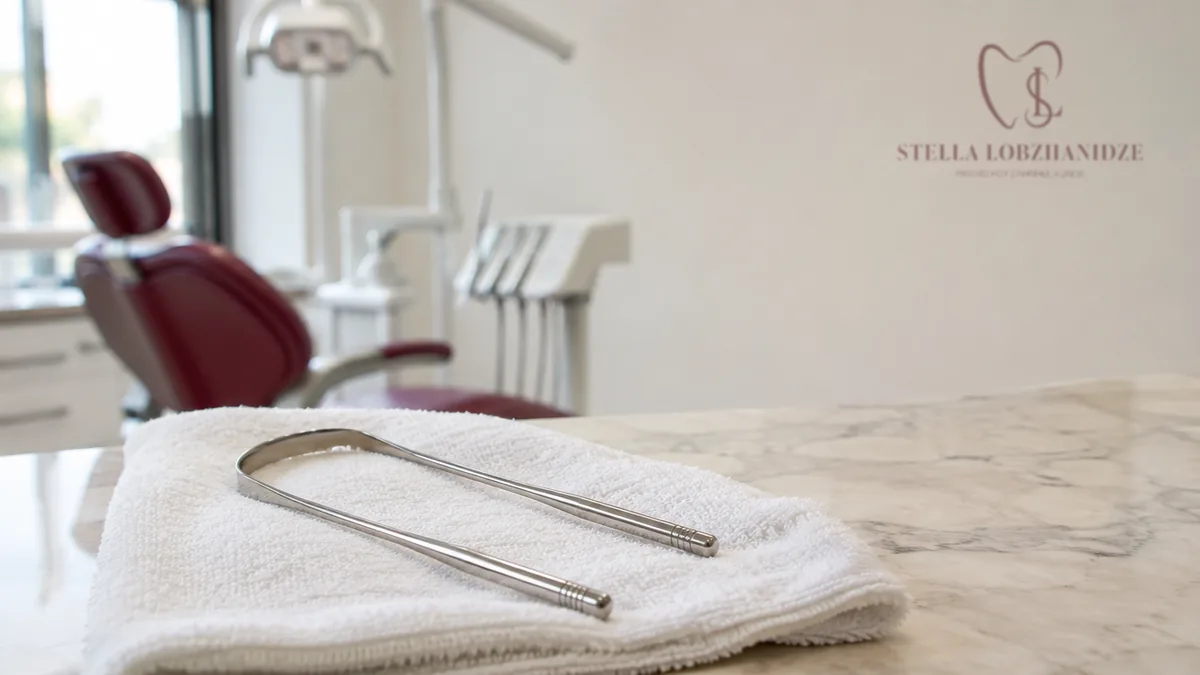
With a tongue cleaner or a toothbrush you remove the coating on the back of your tongue and can reduce bad breath. Tongue cleaning adds to brushing your teeth but does not replace it. A thick or lasting coating should be checked by a dentist.
By Stela Lobzhanidze, dentist in Vienna-Meidling
Published
Key points
- Tongue coating is made up of food debris, bacteria and dead cells.
- The coating is a main source of bad breath, and cleaning reduces the sulphur compounds responsible for it.
- Whether you use a tongue scraper or a toothbrush matters less than a gentle technique.
- A direct protective effect against decay or gum disease has not been clearly shown.
- A thick or lasting coating can have other causes and should be checked.
What causes a white coating on the tongue?
The surface of the tongue is rough. Food debris, bacteria and dead cells get caught on its small bumps, the papillae. Little saliva, smoking, alcohol, coffee and diabetes encourage a coating.
A thick, yellowish-white coating usually points to an imbalance of the bacteria in the mouth. A brown coating is more likely due to smoking or coffee.
Less often, an illness is behind it, such as a fungal infection in the mouth or a change in the lining of the mouth. Digestive conditions and some medicines, such as antibiotics, can also cause a coating.
Do I need to clean my tongue at all?
Many of the bacteria in the mouth collect on the tongue. The German health insurer Techniker Krankenkasse and the NHS therefore advise cleaning the tongue regularly and gently.
However, the research is not entirely consistent. In a small Belgian study of patients with gum disease, the visible coating decreased clearly after two weeks of tongue cleaning, but the number of bacteria in the saliva and on the tongue did not.
Tongue cleaning is therefore a useful extra. Thorough brushing and cleaning between the teeth remain more important.
Does tongue cleaning help with bad breath?
Usually, yes. Bad breath most often starts in the mouth itself and only rarely in the stomach. Tongue coating is considered a main source. Bacteria there produce volatile sulphur compounds that smell unpleasant. Studies show that a tongue cleaner measurably reduces these compounds.
Bad breath can also have other causes, such as gum disease, tooth decay, infections, a dry mouth, acid reflux or smoking. If it persists despite good care, have the cause checked.
Is a tongue scraper better than a toothbrush?
Experts do not agree on this. In the Belgian study there was no difference between a tongue scraper and a toothbrush. Other experts consider tongue brushes more thorough, because scrapers only remove the upper layers of the coating.
A dentist at Tübingen University Hospital recommends combining both: brush first, then scrape. Choose the tool that works well for you and that you will use regularly.
How often and how gently should you clean your tongue?
Clean your tongue once or twice a day, ideally as the last step after flossing and brushing:
- Stick your tongue out in a relaxed way.
- Place the cleaner as far back on the tongue as you can, but only so far that you do not gag.
- Pull it forward to the tip of the tongue with light pressure.
- Rinse the cleaner and repeat three or four times.
- Finally, clean it under running water and let it air dry.
Do not press or scrub too hard, or you may injure your tongue. Replace plastic tongue cleaners about every two to three months. If your tongue is injured, you have a fungal infection or you have had surgery in your mouth, ask your dental practice first.
Can tongue cleaning help prevent tooth decay?
A direct protective effect against decay or gum disease has not been clearly shown. Some experts believe tongue cleaning has a protective effect, but good studies are lacking. Fluoride toothpaste and little sugar are what mainly help against decay.
Whether and from what age a tongue cleaner is suitable for your child is best discussed with your dentist.
How can Stella Dent in Vienna help?
Professional teeth cleaning at our practice in 1120 Vienna-Meidling removes hard and soft deposits, including below the gum line. It helps prevent decay and gum inflammation and also helps against bad breath. You also get tips for your care at home.
You can book an appointment online at stelladent.termin365.at or by phone on +43 1 813 31 23.
Come to the practice if:
- your tongue has a thick coating for a long time
- bad breath does not go away after a few weeks of good care
- your gums are painful, bleeding or swollen
Book an appointment
Book online or give us a call.
Sources
- Apotheken Umschau – So sinnvoll sind Zungenreiniger für die Mundhygiene
- Zahnärztliche Mitteilungen – Zungenreinigung verringert nicht die Bakterienlast
- Zahnärztliche Mitteilungen – Halitosis (2): Zungenreinigung ist kariesprotektiv
- NHS – Bad breath
- Techniker Krankenkasse – Gesund im Mund: Welche Zahnpflege ist die Richtige?
- gesundheit.gv.at – Mundgeruch
- Österreichische Zahnärztekammer – Mundhygiene für zu Hause: 12 Tipps
This article is for general information only and does not replace a dental examination or advice.