Local anaesthesia at the dentist: what you should know
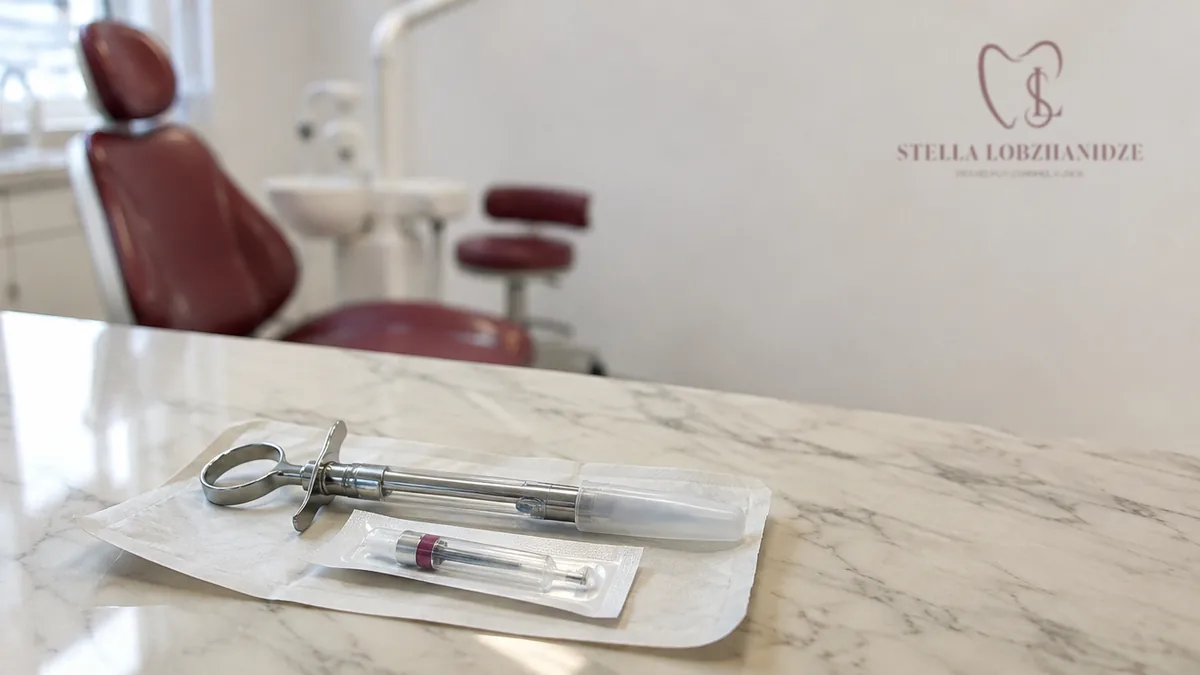
For local anaesthesia at the dentist, a numbing agent is usually injected. It numbs the treatment area for a while so that you feel little or nothing. Serious complications are very rare, but it is important that your dentist knows about your health.
By Stela Lobzhanidze, dentist in Vienna-Meidling
Published
Key points
- Local anaesthesia temporarily numbs the treatment area.
- A numbing gel on the gum can soften the prick of the injection.
- How long the numbness lasts depends on the type of anaesthesia.
- Wait until feeling has fully returned before eating or having hot drinks.
- Your reactions may be slower for several hours, so do not drive yourself.
How does local anaesthesia at the dentist work?
Local anaesthesia temporarily switches off pain sensation in a limited area. Feeling and movement in the lip and cheek are also reduced during this time. Depending on the treatment, there are different types:
- Surface anaesthesia: gel, ointment or spray on the gum, for very small procedures or before the injection
- Infiltration anaesthesia: the agent is injected next to the tooth into the fold between gum and cheek and usually numbs two or three neighbouring teeth.
- Single-tooth anaesthesia: a small amount is injected at the gum margin directly into the tissue holding the tooth.
- Nerve block: the agent is injected near a nerve. In the lower jaw, this numbs half the jaw, half the lip and often half the tongue.
If the effect is not strong enough, your dentist can give a top-up.
Does the injection hurt?
The prick can be briefly unpleasant. Surface anaesthesia with a gel or spray beforehand can soften it.
If you are afraid of the injection, say so. Dentists often ask about dental anxiety at the first visit and plan the treatment together with you.
Besides local anaesthesia, there are sedatives, nitrous oxide or, in exceptional cases, general anaesthesia. Your dentist will discuss with you whether any of these options are suitable for you.
How long does dental anaesthesia last?
That depends on the type of anaesthesia. If only a single tooth is numbed, the effect lasts about 10 to 30 minutes. A nerve block lasts longer and covers a larger area.
During this time, your lip, cheek or tongue feel thick and numb. Swallowing may also feel strange. This is normal and wears off by itself.
After treatment, ask roughly how long you can expect the numbness to last.
Can you eat and drive after local anaesthesia?
Until feeling has fully returned, a few rules apply:
- Do not eat or have hot drinks. You could burn yourself or bite your cheek or tongue.
- Do not drive yourself. Your reactions may be slower for several hours, even if you do not notice it.
- Have someone pick you up or use public transport.
- Ask your dentist when you can drink alcohol, smoke or take sedatives again.
Is dental anaesthesia dangerous?
Serious complications are very rare. Possible side effects include:
- a small bruise at the injection site, more likely with blood thinners or clotting disorders
- a pounding heart, sweating or briefly feeling faint, often triggered by fear of the injection
- difficulty opening the mouth for a few days
- allergic reactions such as swelling, itching or a rash
- very rarely, nerve damage with longer-lasting numbness, which usually goes away
Circulation problems usually improve quickly when you lie down. If you have difficulty breathing or severe circulation problems, call an ambulance on 144.
When should you mention previous problems with anaesthesia?
Always before treatment. To choose the right anaesthesia, your dentist needs some information. Tell them about:
- previous problems with local or general anaesthesia
- allergies, for example to anaesthetics, latex or disinfectants
- medicines, especially blood thinners
- heart and circulation conditions, high blood pressure, diabetes or thyroid disease
- a possible pregnancy
Bring any medical cards you have, such as an allergy card, an anticoagulant card or a pacemaker card.
How do we handle anaesthesia and anxiety at our practice?
At our practice in 1120 Vienna-Meidling, we place fillings, crowns and implants under local anaesthetic. New patients fill in a medical history form about their health, medicines and allergies beforehand. This information is covered by medical confidentiality.
Let us know if you are anxious about treatment. Your dentist will explain each step and talk with you about what helps you.
You can book online at stelladent.termin365.at or call +43 1 813 31 23.
Come to the practice if:
- numbness or tingling lasts longer than you were told
- you can open your mouth much less than usual after treatment
- the pain increases after treatment
- you notice marked swelling, a fever or bleeding that does not stop
See a dentist or the emergency service straight away if:
- you have difficulty breathing or swelling of the face or throat after anaesthesia
- circulation problems do not improve when you lie down
Outside opening hours, you can reach the dental emergency service on +43 1 512 20 78
Book an appointment
Book online or give us a call.
Sources
- Universitätsklinikum Freiburg – Lokalanästhesie beim Zahnarzt (Patienteninformation)
- Gesundheitsportal (gesundheit.gv.at) – Zahnbehandlungsangst
- DGZMK/DGMKG – Verhaltensregeln nach operativen Eingriffen im Mund- und Kieferbereich
- gesundheit.gv.at – Gut vorbereitet in die Arztpraxis
- NHS – Local anaesthesia
This article is for general information only and does not replace a dental examination or advice.