Implant or bridge: which suits a gap in your teeth?
Whether an implant or a bridge suits you better depends mainly on the neighbouring teeth, your jawbone and your general health. A bridge is attached to the neighbouring teeth, while an implant sits in the jaw as an artificial root and leaves those teeth untouched. Both are well-established options, and the choice is made after a thorough examination.
By Stela Lobzhanidze, dentist in Vienna-Meidling
Published
Key points
- A bridge is supported by the teeth next to the gap, an implant is anchored in the jawbone.
- A conventional bridge requires the neighbouring teeth to be ground down, an implant does not.
- An implant needs a surgical procedure and enough jawbone.
- With good care, both options last many years.
- At the ÖGK, bridges and implants are generally private treatments, with a subsidy only in exceptional cases.
What is the difference between an implant and a bridge?
A bridge is a fixed replacement. It spans the gap and is attached to the teeth on either side. These supporting teeth are called abutments.
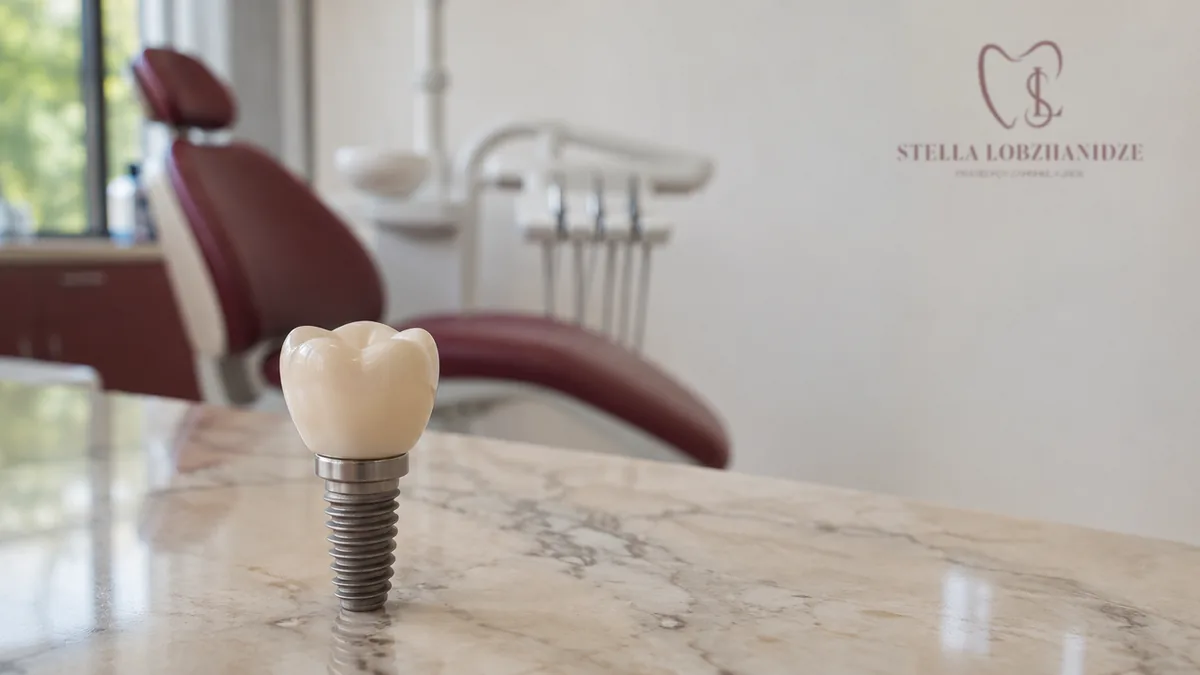
An implant is an artificial tooth root made of titanium or ceramic. It is placed in the jawbone during a small surgical procedure, and the bone grows onto its surface. Later it carries a crown, a bridge or a denture.
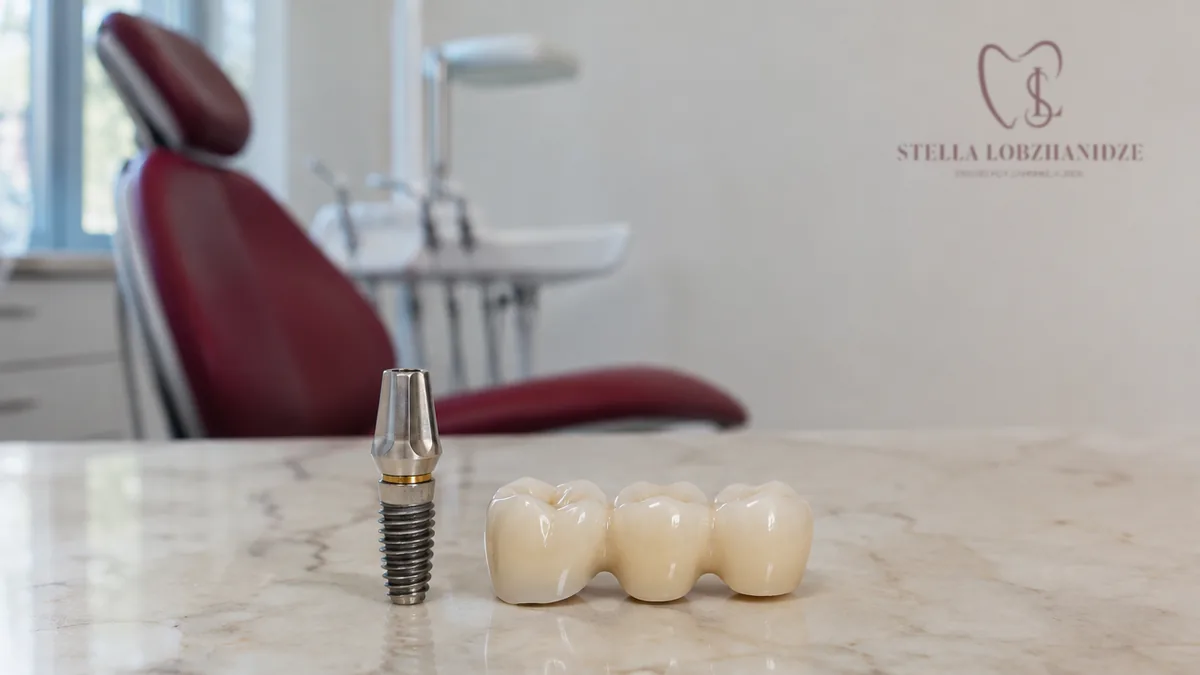
The two can also be combined. For larger gaps, a bridge can rest on implants instead of natural teeth.
What happens to the neighbouring teeth with a bridge?
For a conventional bridge, the neighbouring teeth are ground down and crowned. This removes tooth structure. Sometimes the nerve is damaged and the tooth later needs root canal treatment.
If the neighbouring teeth already have crowns or large fillings, this matters less. A bridge is then often the obvious choice.
An adhesive bridge is held by a small wing bonded to the back of a neighbouring tooth. Little or no drilling is needed. It comes loose a little more often, but can usually be bonded back on.
Implant or bridge: what speaks for which?
There is no single answer for everyone. Your dentist looks closely at the gap, the neighbouring teeth and the jawbone. These points play a role:
- Healthy neighbouring teeth tend to favour an implant, because they do not need to be ground down.
- If they already have crowns or large fillings, a bridge is more likely to be suitable.
- An implant needs enough jawbone. If bone is missing, bone grafting may be needed, and treatment takes longer.
- Smoking, poorly controlled diabetes, past gum disease or certain medicines increase the risk with implants.
- Your age, general health and personal wishes also count.
A bridge needs stable teeth next to the gap or implants that are already in place. If a gap is left open, neighbouring teeth can drift into it over time.
How long do a bridge and an implant last?
Both have been used for a long time. According to patient information from Leeds Teaching Hospitals (NHS), about eight out of ten conventional bridges last ten years or more. Of implants, about nine out of ten are still in place and working after ten years.
These are averages. How long your replacement lasts depends a lot on care and regular check-ups. Clean under a bridge with floss and around an implant with interdental brushes. Your dentist will show you how.
Does health insurance pay for an implant or a bridge?
At the Austrian Health Insurance Fund (ÖGK), crowns, bridges and implants are generally private treatments. There is no general subsidy.
Exceptions apply if a removable denture is not possible for medical reasons, for example after tumour surgery in the mouth or with a cleft lip and palate. The fund checks this in advance.
Other insurance funds have their own rules. It is best to ask your fund before treatment and to get the costs in writing beforehand.
How do you find the right solution in Vienna?
At our practice in 1120 Vienna-Meidling, we offer crowns and bridges as well as implants. Dentist Stela Lobzhanidze examines the gap and discusses with you which options are available in your case.
Before any treatment, you receive a detailed cost estimate. We bill SVS and KFA directly; with other insurance funds we treat you as a Wahlärztin (private dentist) and help you submit your bill.
You can book an appointment on +43 1 813 31 23 or online at stelladent.termin365.at.
Come to the practice if:
- you have a missing tooth and would like to close the gap
- a tooth needs to be removed and you want to plan its replacement in good time
- an existing bridge is wobbly or has come loose
- the gum around a bridge or implant bleeds or is swollen
Book an appointment
Book online or give us a call.
Sources
- IQWiG (gesundheitsinformation.de) – Kronen, Brücken, Implantate: Welche Arten von Zahnersatz gibt es?
- Leeds Teaching Hospitals NHS Trust – Bridges
- Leeds Teaching Hospitals NHS Trust – Dental implants
- ÖGK – Zahnersatz
- gesundheit.gv.at – Zahnersatz
- gesundheit.gv.at – Zahnimplantate
- rauchfrei.at (ÖGK) – Rauchen und Mundgesundheit
This article is for general information only and does not replace a dental examination or advice.