Dental implants with diabetes or if you smoke: what you should know
A dental implant is possible in many cases with diabetes, as long as blood sugar is well controlled and follow-up care matches your personal risk. Smoking, on the other hand, increases the risk that an implant causes problems later or is lost. Your dentist should know about both before planning treatment.
By Stela Lobzhanidze, dentist in Vienna-Meidling
Published
Key points
- According to a German guideline, diabetes is no longer a general reason to rule out dental implants.
- Poorly controlled blood sugar can delay healing and raise the long-term risk of inflammation around the implant.
- Smoking is one of the most important risk factors for late problems and implant loss.
- Ideally, stop smoking before treatment and stay smoke-free afterwards.
- With diabetes, follow-up care should be based on your personal risk.
Can I have a dental implant if I have diabetes?
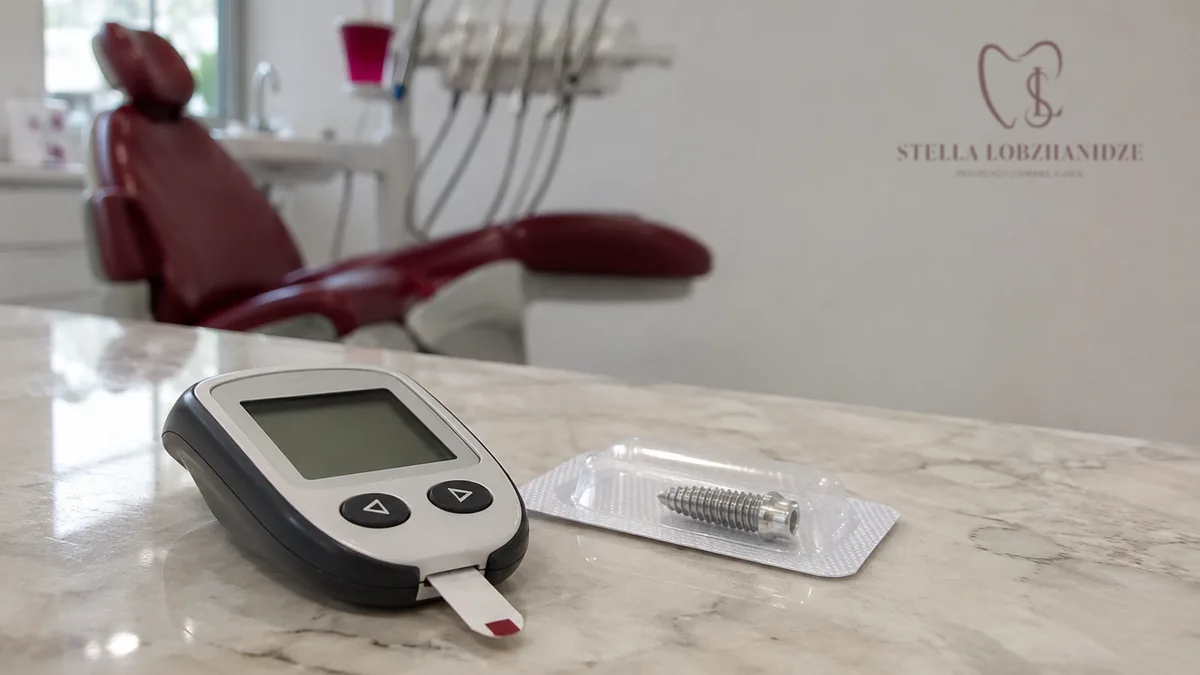
In many cases, yes. The German S3 guideline on dental implants in diabetes mellitus no longer regards diabetes as a general reason to rule out implants. What matters is careful planning and an approach that takes your personal risk into account.
The guideline recommends that blood sugar should be within the target range set by medical diabetes guidelines. Your doctor decides which value applies to you.
How does blood sugar affect the implant?
With poorly controlled diabetes, the implant may bond with the bone more slowly. After one year, however, studies found no difference in stability.
In the long term, the risk of inflammation around the implant (peri-implantitis) and of implant loss seems to rise with diabetes. With poorly controlled diabetes, the guideline therefore advises caution if an implant is to be loaded immediately or very early.
Existing gum disease should be treated before the implant is placed. The guideline recommends this too.
Is the risk for a dental implant higher in smokers?
Yes. Smoking is one of the most important factors in whether an implant is suitable at all. It increases the risk that the gum and bone around the implant become inflamed later and that the implant is lost.
Other risk factors include poor oral hygiene, past gum disease, radiotherapy to the jaw and certain medicines such as bisphosphonates. If several come together, particularly careful planning is needed.
Do I have to stop smoking before an implant?
Your dentist will advise you to. Hospitals in England recommend stopping before treatment and staying smoke-free for good afterwards. The risk is not limited to the healing phase; it continues years later.
If quitting is hard for you, get support, for example from your GP.
What should you clarify before implant surgery?
Tell your dentist openly whether you smoke, how your diabetes is treated and which medicines you take. If you have it, bring your latest long-term blood sugar value (HbA1c).
With diabetes, it makes sense to coordinate with your GP or diabetes specialist. According to the guideline, your dentist should also ask about your HbA1c during follow-up and arrange a medical check if needed.
With poorly controlled diabetes, after radiotherapy to the head and neck, or while taking medicines such as bisphosphonates, placing an implant straight after a tooth is removed is planned with caution. It is often better to wait for healing first.
Do I need closer check-ups after an implant if I have diabetes?
For people with diabetes, the guideline recommends follow-up care based on your risk. It does not set fixed intervals. Your dentist will agree with you how often you should come.
For all implants, thorough daily cleaning and regular check-ups are the best prevention. This applies even more to smokers and people with diabetes.
How do we deal with these risks in Vienna?
At our practice in 1120 Vienna-Meidling, new patients fill in a medical history form about their health, medicines and allergies. The information is protected by medical confidentiality.
Dentist Stela Lobzhanidze examines you, plans the implant and talks openly with you about what diabetes or smoking means in your case. You can book on +43 1 813 31 23 or online at stelladent.termin365.at.
Come to the practice if:
- you have diabetes or smoke and are thinking about an implant
- the gum around an implant bleeds, is red or swollen
- an implant or the crown on it feels loose
- the wound after implant surgery is not clearly better after a week
Book an appointment
Book online or give us a call.
Sources
- AWMF / DGI – S3-Leitlinie Zahnimplantate bei Diabetes mellitus
- Leeds Teaching Hospitals NHS Trust – Dental implants
- Guy's and St Thomas' NHS Foundation Trust – After having a dental implant
- DGZMK / DGI – S2k-Leitlinie Implantationszeitpunkte (2022)
- rauchfrei.at (ÖGK) – Rauchen und Mundgesundheit
- AWMF / DGI – S3-Leitlinie Behandlung periimplantärer Infektionen an Zahnimplantaten (2022)
- AWMF / DGI – S3-Leitlinie Zahnimplantate bei medikamentöser Behandlung mit Knochenantiresorptiva (2026)
This article is for general information only and does not replace a dental examination or advice.