Smoking, teeth and gums: what happens in your mouth?
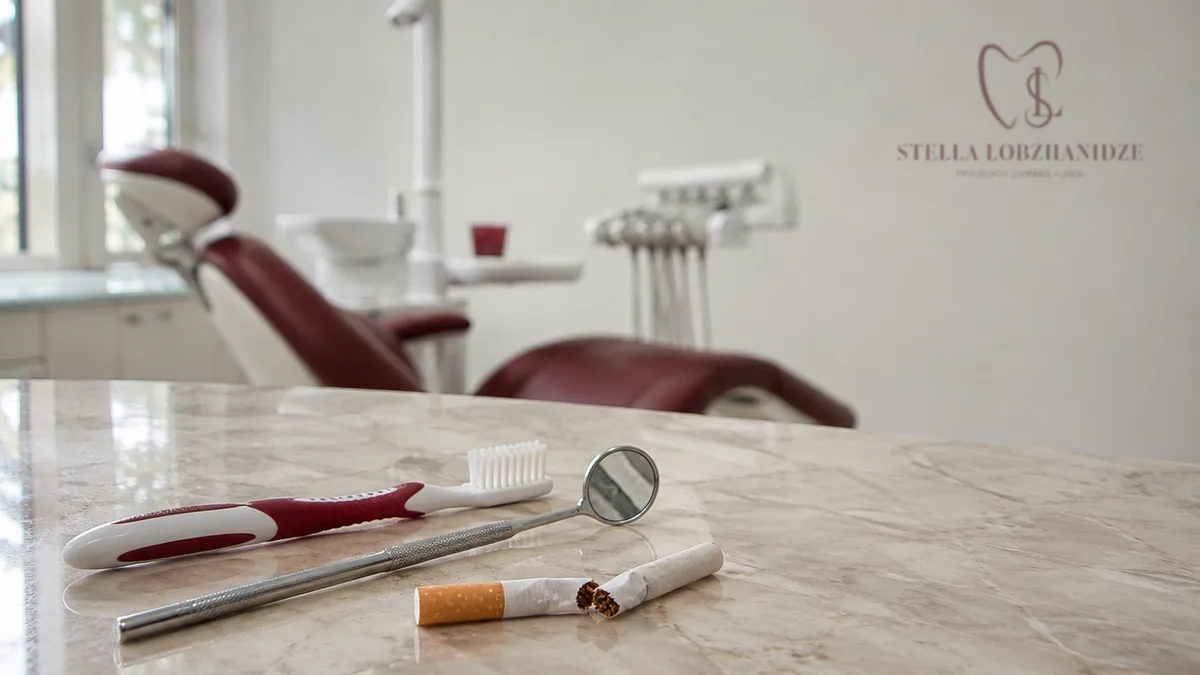
Smoking harms teeth and gums in several ways. It raises the risk of gum disease (periodontitis), tooth decay and tooth loss, stains the teeth and slows down healing. Quitting lowers these risks again.
By Stela Lobzhanidze, dentist in Vienna-Meidling
Published
Key points
- Smokers develop periodontitis much more often, and the more they smoke, the higher the risk.
- Because smoking can mask bleeding gums, periodontitis is often noticed late.
- Nicotine and tar stain teeth and dentures.
- Wounds in the mouth heal less well, and implants are lost more often.
- After quitting, the risks go down and taste and breath improve.
How does smoking harm teeth and gums?
Tobacco smoke contains thousands of substances that act directly on the teeth and the lining of the mouth. According to the German Cancer Research Center (DKFZ), smoking shifts the balance of bacteria in the mouth towards harmful germs. At the same time, less saliva flows, which would normally protect the teeth. Possible effects include:
- more gum disease and periodontitis
- a higher risk of tooth decay
- stains on teeth and dentures
- bad breath and a weaker sense of taste
- precursors of mouth cancer, such as white patches (leukoplakia)
Chewing tobacco, snus, water pipes and heated tobacco products also harm the mouth. There is no reliable long-term assessment of e-cigarettes yet.
Does smoking increase the risk of periodontitis?
Yes. Smoking is one of the most important risk factors for periodontitis, the inflammation of the tissues that hold the teeth in place. The more someone smokes, the higher the risk.
The tricky part is that typical warning signs are often missing in smokers. The gums are less red and bleed less often. As a result, the inflammation is often discovered late. Smokers also respond less well to treatment.
Why do smokers often have dark stains on their teeth?
Nicotine and tar build up on teeth, fillings and dentures and turn them yellow to brown.
As long as you keep smoking, neither brushing nor whitening can remove these stains completely. During a professional teeth cleaning, deposits are removed and the teeth are polished. After quitting, stains fade noticeably.
Do smokers lose teeth earlier, and do wounds heal less well?
Smokers lose teeth more often. Untreated periodontitis gradually loosens the teeth until they may fall out.
Smoking also impairs wound healing in the mouth. With dental implants, there is a higher risk that they do not grow in or are lost later. Before planned treatment, talk openly with your dentist about smoking.
Do the gums improve after quitting smoking?
Yes. Soon after quitting, taste and smell improve and bad breath disappears. Stains fade, and wounds after procedures in the mouth heal better.
The risk of periodontitis falls step by step. According to a specialist article on rauchfrei.at, it returns to the level of non-smokers after about eleven years. The risk of mouth cancer also drops, and dental treatments work better.
Can my dentist help me quit smoking?
Yes. Your dentist can talk openly about smoking, advise you and point you to support services. Only a few people manage to stay smoke-free on their own. With professional help, it works more often.
In Austria, the Rauchfrei Telefon quit line offers advice on 0800 810 013, Monday to Friday from 10 am to 6 pm, anonymously if you wish. You can find more information at rauchfrei.at.
How can our practice in Vienna support you?
If you smoke, regular preventive care is especially important because gum disease often goes unnoticed. At our practice in 1120 Vienna-Meidling we offer professional teeth cleaning. It removes hard and soft deposits, including below the gum line, and helps against staining.
If you have periodontitis, we treat it over several sessions. Bacteria and deposits are removed, including below the gum line. The earlier treatment starts, the better.
You can book an appointment on +43 1 813 31 23 or online at stelladent.termin365.at.
Come to the practice if:
- your gums are red, swollen or bleeding
- teeth feel loose or your gums are receding
- you notice persistent bad breath
- you find a white patch in your mouth
Book an appointment
Book online or give us a call.
Sources
- Deutsches Krebsforschungszentrum – Rauchen und Mundgesundheit (Fakten zum Rauchen 2024)
- rauchfrei.at (ÖGK) – Rauchen und Mundgesundheit
- rauchfrei.at – Rauchen Sie? Warum der Zahnarzt den Rauchstopp empfehlen sollte
- gesundheit.gv.at – Parodontitis
- gesundheit.gv.at – Gesundheitliche Folgen des Rauchens
- gesundheitsinformation.de (IQWiG) – Zahnfleischentzündung und Parodontitis
This article is for general information only and does not replace a dental examination or advice.