When should your child first see a dentist?
Ideally, your child's first dental visit should take place soon after the first baby tooth comes through. The first appointment is mainly about getting to know each other. A few simple steps will help you prepare your child well.
By Stela Lobzhanidze, dentist in Vienna-Meidling
Published
Key points
- Ideally, the first dental visit takes place soon after the first baby tooth appears.
- During the kindergarten years, a check-up twice a year is recommended.
- Talk positively about the dentist and avoid words like injection or drill.
- Up to the age of two, a rice-grain-sized amount of children's toothpaste with 1,000 ppm fluoride is enough, after that a pea-sized amount.
- Parents should brush their child's teeth after them until the child can write fluently.
When should your child first see a dentist?
According to the Austrian health portal, the first dental visit should ideally take place as soon as the first baby tooth has come through. The first teeth usually appear between the fifth and tenth month.
During the kindergarten years, a check-up twice a year is recommended. If your child has never been to a dental practice, book an appointment soon.
Teeth are also part of the Austrian Parent-Child Pass (Eltern-Kind-Pass). At the check-up in the 7th to 9th month, the teeth are looked at. If anything unusual is found, the child should be referred to a dentist.
From the check-up in the 10th to 14th month onwards, the Parent-Child Pass recommends a dental examination at every further child check-up.
In Germany, six dental screening check-ups are provided between the age of six months and five years.
How can you prepare your child for the visit?
How your child experiences the appointment depends partly on you. The University Clinic of Dental Medicine in Graz and the Austrian health portal give this advice:
- Only talk positively about your own dental visits when your child is listening.
- Don't let your child sense your own fear of the dentist, as fear is passed on through body language.
- Picture books and stories about teeth make the topic playful.
- Only describe the general routine, as words like injection or drill often frighten children.
- Avoid phrases like ‘Don't be scared!’, because children mainly hear the word scared.
- If your child has heard about other people's bad experiences, talk it through calmly with them.
The health portal also advises choosing a practice that enjoys treating children and takes its time.
What happens at the first appointment?
At our practice, the first visit is about getting to know each other, not about treatment. Your child can try out the dental chair, get to know the instruments and ask questions. As a parent, you can stay in the treatment room.
The German Federal Ministry of Health describes a dental screening check-up for young children like this:
- The mouth and teeth are examined.
- The risk of tooth decay is assessed.
- Parents receive advice on diet and oral hygiene.
- Suitable fluoride products to strengthen tooth enamel are recommended.
Praise your child for small successes too. Praise is especially motivating for children.
How should you brush your child's teeth?
Tooth care starts with the first baby tooth. Brush your child's teeth carefully twice a day.
Use a fluoride toothpaste. The Austrian health portal gives these amounts:
- Up to the age of two, a rice-grain-sized amount of children's toothpaste with 1,000 ppm fluoride
- From the age of two, a pea-sized amount with 1,000 ppm fluoride
- After the age of six, toothpaste with 1,000 to 1,500 ppm fluoride
Many children learn the KAI order. First the biting surfaces, then the outer surfaces and finally the inner surfaces.
Keep brushing after your child until late primary school age. As a rule of thumb, do this until your child can write fluently. Before then, fine motor skills are usually not good enough for the right brushing technique.
What protects baby teeth in everyday life?
Simple habits help alongside brushing. The health portal recommends:
- Don't lick dummies, bottle teats or baby spoons yourself, so that no decay-causing bacteria are passed on.
- Don't coat dummies with honey, syrup or sugar.
- From the first birthday, let your child drink only from a cup or glass where possible.
- Offer water or unsweetened tea and avoid sweet drinks and juices where possible.
- Leave breaks between meals so that saliva can remineralise the teeth.
How do fluoride varnish and fissure sealants help?
Fluoride varnish is applied to the teeth at the dental practice and hardens the tooth enamel. In Germany, it is provided twice a year for young children from 6 to 33 months.
At our practice, we paint fluoride varnish onto the teeth of children under six with a fine brush. This is possible from the first baby tooth. For teenagers, we offer fluoride treatment with a soft gel tray. We recommend fluoride treatment twice a year at check-up or hygiene appointments.
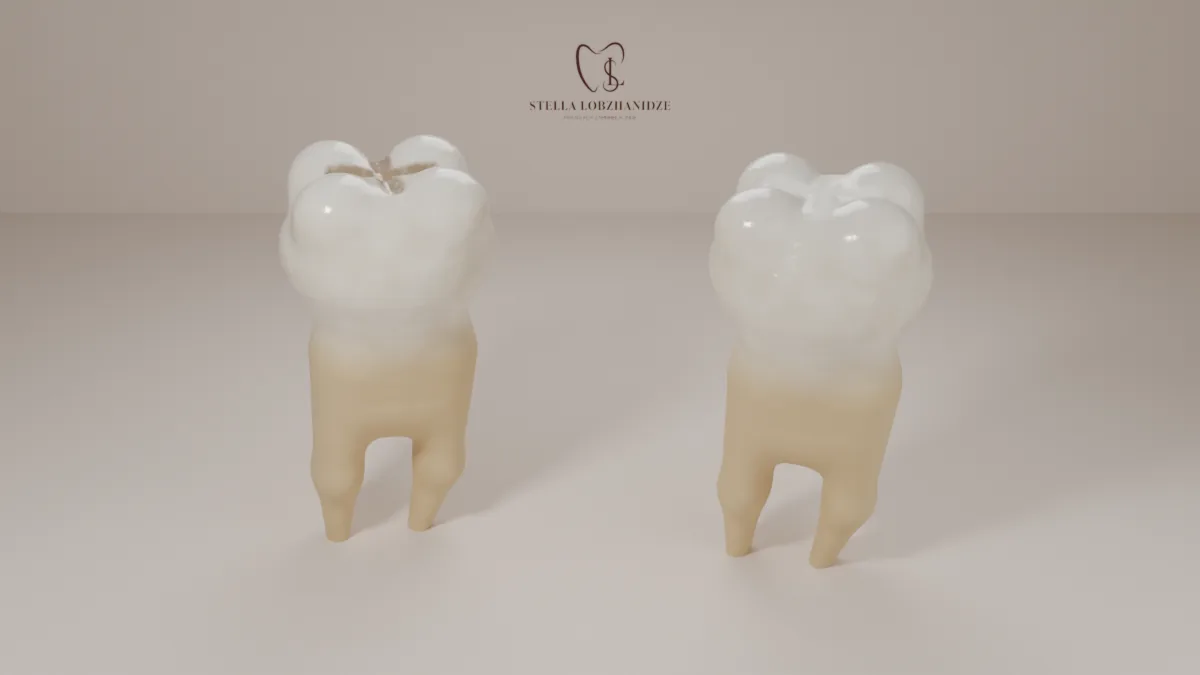
The back teeth have deep grooves on their biting surfaces, called fissures. With fissure sealants, decay-free fissures are closed with a sealing material. In Germany, they are provided for children and teenagers aged 6 to 18 who are particularly prone to decay.
The first permanent molars usually come through at 6 to 7 years, the second at 11 to 13 years. Sealants only protect the biting surfaces, so thorough brushing is still important. At check-ups, we inspect the sealants and renew them if needed.
Come to the practice if:
- The first baby tooth has come through and your child has never been to a dental practice
- Something unusual was noticed about the teeth at a Parent-Child Pass check-up
- Your child is of kindergarten age and the last check-up was more than six months ago
- The first permanent molars have come through and you would like to discuss fissure sealants
Book an appointment
Book online or give us a call.
Sources
- Austrian health portal (gesundheit.gv.at) – Zahnpflege für Säuglinge und Kinder
- Gesundheit Österreich GmbH – Parent-Child Pass, notes on child check-ups (PDF, German)
- LKH-Univ. Klinikum Graz – Zahnarztbesuch mit ängstlichen Kindern (PDF, German)
- gesund.bund.de – Mundhygiene und Zahnvorsorge für gesunde Zähne (German)
- German Federal Ministry of Health – Zahnvorsorgeuntersuchungen (German)
This article is for general information only and does not replace a dental examination or advice.