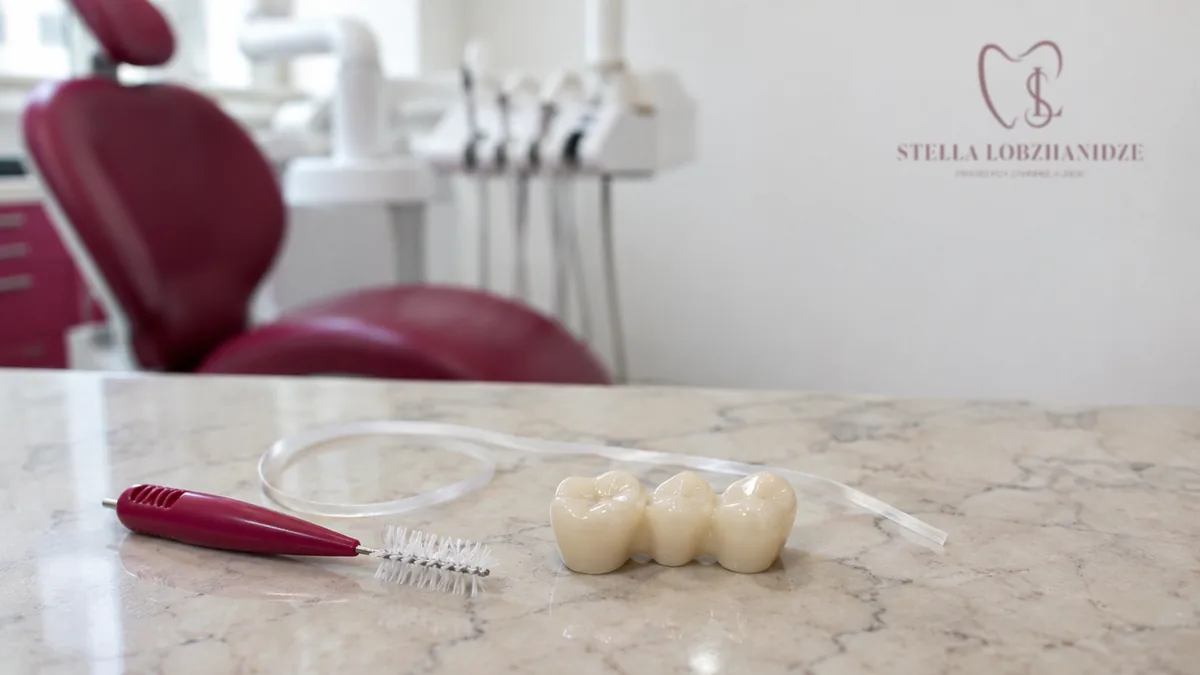
A hole in the tooth without pain: does it need treatment?
A hole in a tooth should be treated even if it does not hurt. Tooth decay often causes no symptoms at first, but it keeps progressing. The earlier it is treated, the smaller the procedure usually is.
By Stela Lobzhanidze, dentist in Vienna-Meidling
Published

Key points
- Early tooth decay often causes no symptoms.
- Pain usually starts only once the decay has reached the dentine.
- Early decay without a hole can heal again with fluoride.
- Once a hole has formed, the tooth usually needs a filling.
- Left untreated, decay can reach the nerve and lead to root canal treatment or loss of the tooth.
Why does a hole in a tooth sometimes not hurt?
Decay starts in the enamel and at first causes no pain there. Only when it reaches the dentine underneath does the tooth become sensitive. With deep decay it may even hurt at rest.
This is why even a small hole can go unnoticed for a long time. No pain does not mean everything is fine.
How can you tell you have decay if there is no pain?
Look out for these signs:
- rough white spots in the enamel
- brown or black spots on the tooth
- a visible hole in the tooth
- a twinge with cold, hot or sweet things
You cannot see many of these spots yourself, for example between the teeth or under an old filling. That is why regular check-ups matter. Your dentist usually finds decay with a careful examination, and an X-ray helps if needed.
Does a hole in a tooth get bigger if you do nothing?
Yes, decay usually keeps progressing. It moves from the enamel into the dentine and from there into the pulp, where the nerve lies.
Without treatment, the nerve can become inflamed. Later, inflammation can develop at the root tip, or an abscess, which is a painful collection of pus. In the worst case, the tooth is lost.
So there is no general answer to how long you can wait with a hole. Have it checked as soon as possible.
Does early decay heal by itself?
Not by itself, but often with a little help. Early decay without a hole can heal. Fluoride toothpaste and fluoride gel or varnish at the dentist help the enamel take up minerals again. For mild forms, caries infiltration is also possible.
Decay can also come to a standstill if the cause is removed, for example by eating less sugar.
Once a hole has formed, this is no longer enough. The tooth then usually needs a filling.
When does a hole in a tooth need a filling?
As soon as there is a hole in the tooth surface, the decay is removed and the tooth is filled. Possible materials include composite or ceramic. What exactly is needed depends on how deep the decay goes:
- early decay without a hole: fluoride or caries infiltration
- hole in the tooth: filling
- larger damage: partial crown or crown
- decay has reached the nerve: usually root canal treatment
- tooth can no longer be saved: removal and replacement, for example with a bridge or an implant
The earlier treatment starts, the more of your own tooth can usually be preserved.
How do we treat a hole in a tooth at our practice?
At our practice in 1120 Vienna-Meidling, we gently remove the decay under local anaesthetic. We then rebuild the tooth layer by layer with tooth-coloured composite. Each layer is hardened with light. Finally, we check the shape and bite and polish the filling.
For larger defects, there are ceramic inlays made in a dental laboratory. We can also make decay between the teeth visible with the DIAGNOcam, without X-ray radiation.
Before any treatment, you receive a cost estimate. You can book online at stelladent.termin365.at or call +43 1 813 31 23. If you are in severe pain, please call first; we keep emergency appointments free every day. Outside opening hours, the Vienna dental emergency service is available on +43 1 512 20 78.
Come to the practice if:
- you notice a hole or dark spots on a tooth, even without pain
- a tooth reacts to cold, hot or sweet things
- you have sharp pain when eating or drinking
- your gums are painful, swollen or bleed when you brush
See a dentist or the emergency service straight away if:
- you have very severe toothache
- your cheek or gum swells up
- you also develop a fever
Outside opening hours, you can reach the dental emergency service on +43 1 512 20 78
Book an appointment
Book online or give us a call.
Sources
- Gesundheitsportal (gesundheit.gv.at) – Karies: Was ist das?
- IQWiG (gesundheitsinformation.de) – Karies
- NHS – Tooth decay
- gesundheit.gv.at – Zahnfüllungen
- gesundheit.gv.at – Wurzelbehandlung und Wurzelspitzenresektion
This article is for general information only and does not replace a dental examination or advice.