All-ceramic or metal-ceramic crown: which suits you?
An all-ceramic crown is made entirely of ceramic, while a metal-ceramic crown has a metal core with a ceramic layer on top. Both are tooth-coloured and well proven for single front and back teeth. Which is the better fit depends on the tooth, your bite, any allergies and your own wishes.
By Stela Lobzhanidze, dentist in Vienna-Meidling
Published
Key points
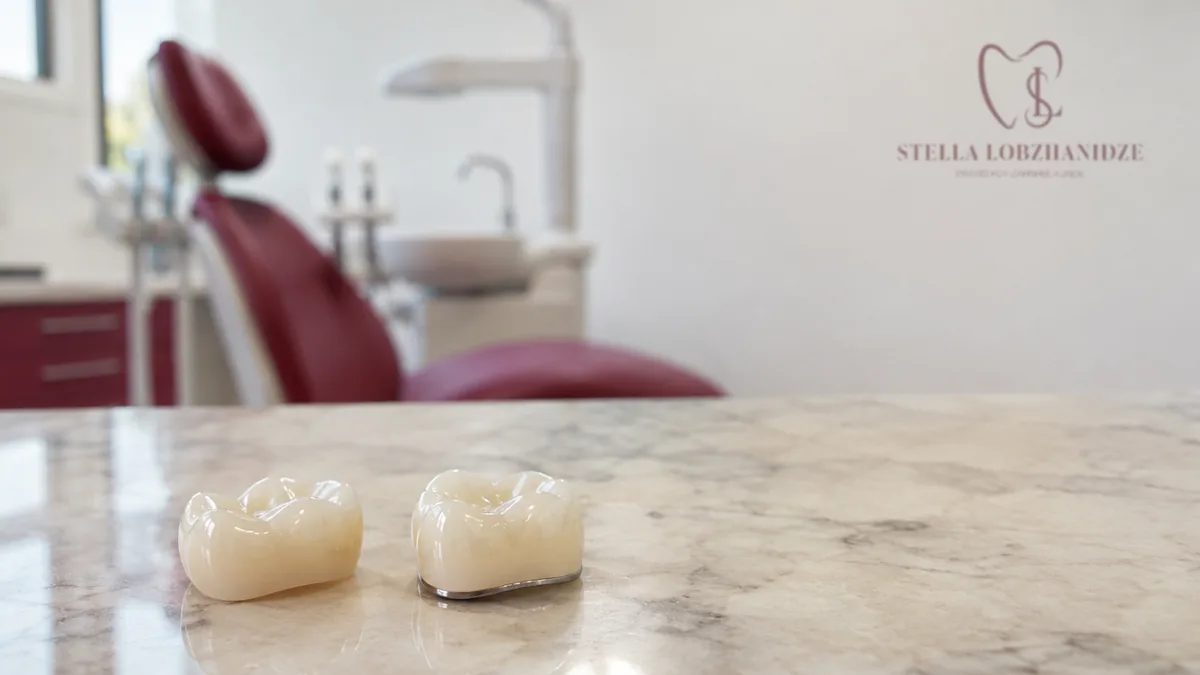
- Metal-ceramic crowns have a core made of a metal alloy that is covered with ceramic.
- All-ceramic crowns contain no metal and look particularly natural.
- For single crowns on front and back teeth, studies show similar survival to metal-ceramic crowns.
- Grinding your teeth puts more strain on any crown, so the material is chosen with special care.
- If you have a known metal allergy, only metal-free restorations are an option.
What is the difference between all-ceramic and metal-ceramic?
A crown covers a badly damaged tooth completely and stabilises it. There are several material options:
- Metal-ceramic crown: a core made of a precious or non-precious metal alloy is covered with ceramic. It is the most commonly used type of crown.
- All-ceramic crown: it contains no metal. On front teeth it often consists of a strong, tooth-coloured core, for example made of zirconia, with layers of ceramic on top. On back teeth, single-layer crowns made of high-strength ceramic are often used.
- Full metal crown: it is made entirely of metal and, because of its colour, is mainly used for back teeth that do not show.
Today, ceramic materials are the most common choice for crowns.
Is an all-ceramic crown better than metal-ceramic?
Not as a rule. Both types of crown have strengths and weaknesses.
In favour of all-ceramic: it can be made to look very natural, it is well tolerated and often less of the tooth has to be removed. On the other hand, fitting it is more complex, and the wide choice of ceramics does not make the decision any easier.
Metal-ceramic has been in use for a long time and serves as the benchmark in studies. It combines strength with a tooth-coloured appearance. However, the tooth usually needs to be reduced a little more to make room for the ceramic layer.
Which crown is suitable for front and back teeth?
On front teeth, a tooth-coloured crown always makes sense. Both metal-ceramic and all-ceramic are options here.
On back teeth, all-ceramic and metal-ceramic are also possible. Where the tooth is hardly visible and has to withstand a lot of biting force, a metal crown can also be a sensible choice.
Bridges are a different matter: according to the professional society, all-ceramic bridges on back teeth are only partly as well studied as metal-ceramic ones.
Do all-ceramic crowns last as long as metal-ceramic ones?
For recommended all-ceramic single crowns on front and back teeth, studies show survival rates comparable to those of metal-ceramic crowns.
Crowns generally last a long time, normally around eight to ten years. Good care and regular check-ups help them last longer, whatever material the crown is made of.
A crowned tooth can still get decay, for example if the gum recedes or plaque stays at the edge of the crown. So brush twice a day with fluoride toothpaste and clean between your teeth every day.
What applies if you grind your teeth or have a metal allergy?
Heavy grinding or clenching puts any restoration at risk, whatever it is made of. Metal absorbs biting force better. There is less reliable data on all-ceramic crowns in people who grind. In this case, dentists usually recommend a bite splint.
If you have a known metal allergy, only metal-free restorations are an option. All-ceramic avoids possible reactions to metal from the outset.
So tell your dentist if you grind your teeth or react to metals.
Does health insurance pay for an all-ceramic crown?
At the Austrian health insurance fund ÖGK, crowns count as fixed dental restorations and are in principle a private service. Subsidies are only available in certain medical special cases, for example if a removable restoration is not possible for medical reasons.
Ask about the costs before treatment and check with your health insurance fund what applies in your case.
How do we advise you at Stella Dent in Vienna?
At our practice in 1120 Vienna-Meidling, we make crowns from materials including all-ceramic and zirconia. The tooth is prepared under local anaesthetic and an impression is taken. You wear a temporary crown until the final one is ready.
We discuss with you beforehand which material suits your tooth. You receive a detailed cost estimate. We bill SVS and KFA directly, and with other insurance funds we help you submit your claim.
You can book an appointment on +43 1 813 31 23 or online at stelladent.termin365.at.
Come to the practice if:
- a crown wobbles, presses or its edge feels rough
- a piece of ceramic has chipped off a crown
- you grind your teeth and a new crown is planned
- the gum around a crown bleeds or is receding
Book an appointment
Book online or give us a call.
Sources
- KZBV – Patienteninfos: Kronen
- DGZMK – Patientenleitlinie Vollkeramische Kronen und Brücken
- gesundheit.gv.at – Zahnersatz: Kronen und Brücken
- Leeds Teaching Hospitals NHS Trust – Crowns
- ÖGK – Zahnersatz
- gesundheit.gv.at – Zähneknirschen (Bruxismus)
- IQWiG (gesundheitsinformation.de) – Kronen, Brücken, Implantate: Welche Arten von Zahnersatz gibt es?
This article is for general information only and does not replace a dental examination or advice.