Dental floss or interdental brush: which suits your teeth?
Whether dental floss or an interdental brush is better depends mainly on the gaps between your teeth. Floss works well for tight gaps, while interdental brushes are the first choice for wider gaps and for periodontitis. What matters is that you clean between your teeth every day.
By Stela Lobzhanidze, dentist in Vienna-Meidling
Published
Key points
- A toothbrush only reaches about 70 percent of the tooth surface, and the gaps between teeth often stay uncleaned.
- Floss suits tight gaps, while interdental brushes suit wider gaps, bridges, implants and periodontitis.
- Interdental brushes come in different sizes, and the right one is best chosen at the dental practice.
- Bleeding gums are often a sign of inflammation and should be checked if the bleeding does not stop.
- Clean between your teeth once a day, in addition to brushing.
Dental floss or interdental brush: which is better?
It depends on how wide the gaps are. The German Dental Association still considers floss the method of choice for tight gaps. For open gaps and for periodontitis, it recommends interdental brushes.
The European guideline on treating periodontitis goes further. For people with periodontitis, interdental brushes are the preferred choice wherever they fit. Floss is not recommended as the first choice for this group, but it can help where no brush fits.
The research on floss is weak. That does not mean that less thorough cleaning is enough.
Does flossing replace brushing?
No. Floss and interdental brushes add to brushing, they do not replace it. Keep brushing twice a day with fluoride toothpaste.
The gaps still need their own care. A toothbrush only reaches around 70 percent of the tooth surface. In adults, tooth decay and periodontitis often develop exactly where the brush cannot reach.
What size of interdental brush do you need?
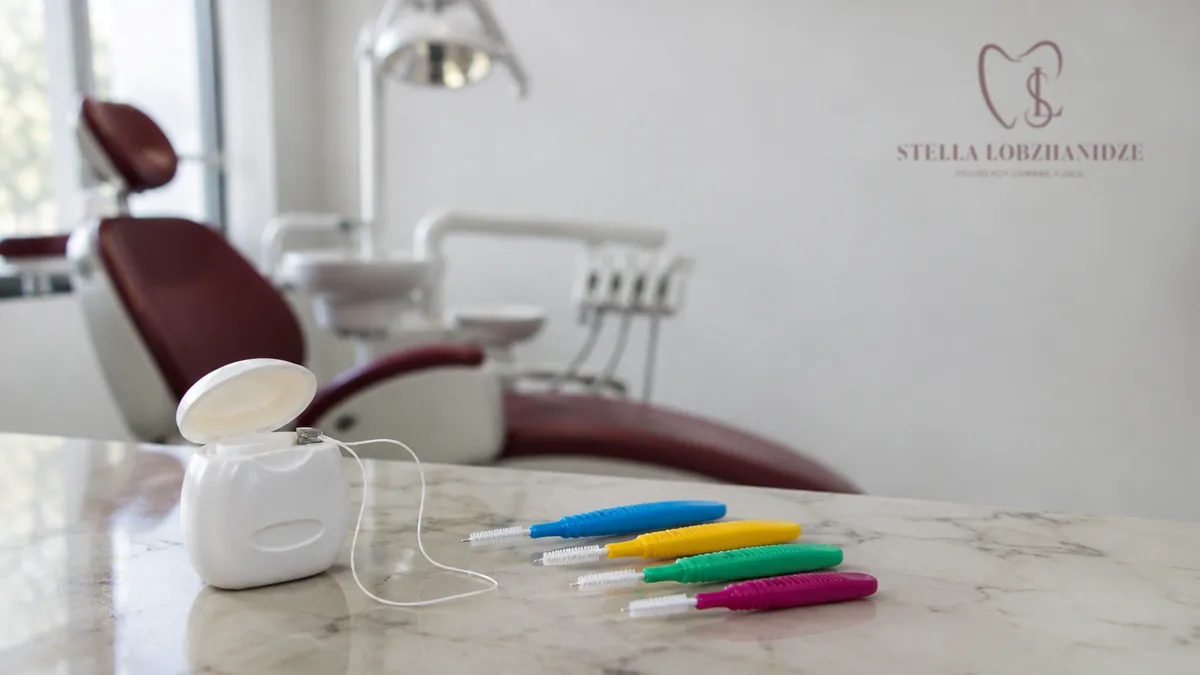
Interdental brushes come in many sizes. The right one depends on how wide your gaps are, and not every gap is the same width.
The Austrian Dental Chamber advises having the right size chosen for you at the practice, for example by the prophylaxis assistant. There you will also be shown how to use it. This matters, because correct handling decides how useful it is.
How do you use dental floss correctly?
There are different kinds of floss. Ask your dental practice which one suits you. This is how to do it:
- Guide the floss gently between two teeth without letting it snap into the gum.
- Wrap it around the curve of one tooth and move it gently up and down.
- Repeat on the neighbouring tooth.
- Work your way from gap to gap, including at the back between the molars.
For interdental brushes: insert the brush gently into the gap without forcing it and move it back and forth a few times. If it only goes in with force, ask your practice about a different size.
Do gums bleed at first?
If your gums bleed when you brush or clean between your teeth, this is often a sign of gum inflammation. The cause is usually plaque that is not removed thoroughly.
So do not stop cleaning between your teeth. Be gentle so you do not injure the gums. According to the NHS, better cleaning at home and a professional cleaning often help in the early stages.
If your gums keep bleeding despite careful cleaning, have them checked by a dentist.
How often should you clean between your teeth?
Once a day, done thoroughly, is enough. Many people do it in the evening, when they have time to brush calmly anyway.
Sometimes it makes sense to combine both: floss for the tight spots and interdental brushes for wider gaps. For bridges and implants, interdental brushes are usually better. If you wear fixed braces, ask to be shown which aids suit you.
How can prophylaxis in Vienna-Meidling help you?
During a professional dental cleaning at our practice in 1120 Vienna-Meidling, we remove deposits between the teeth and below the gum line. Your teeth are then polished and treated with fluoride.
You also get personal tips for home care, including whether floss or interdental brushes suit you better. To book an appointment, call +43 1 813 31 23 or book online at stelladent.termin365.at.
Come to the practice if:
- your gums keep bleeding despite daily care
- your gums are swollen, red or tender
- you have bad breath that does not go away
- you do not know which size of interdental brush you need
Book an appointment
Book online or give us a call.
Sources
- Bundeszahnärztekammer – Zahnseide
- EFP – Treatment of stage I–III periodontitis: The EFP S3 level clinical practice guideline (J Clin Periodontol 2020)
- gesundheit.gv.at – Zahngesundheit
- Österreichische Zahnärztekammer – Mundhygiene für zu Hause: 12 Tipps
- NHS – Gum disease
- Cochrane – Home use of devices for cleaning between the teeth (in addition to toothbrushing) to prevent and control gum diseases and tooth decay (2019)
- gesundheit.gv.at – Gingivitis – Zahnfleischentzündung
This article is for general information only and does not replace a dental examination or advice.