Lasers in dentistry: what can they really do?
A laser in dentistry is a tool for certain tasks, not a replacement for proven treatments. For tooth decay, there are signs that it causes less pain, but the studies are weak. For periodontitis, the European guideline advises against routinely using it as an add-on.
By Stela Lobzhanidze, dentist in Vienna-Meidling
Published
Key points
- Dental lasers use focused light, and depending on the wavelength they act differently on hard tooth tissue and soft tissue.
- In periodontitis treatment, a laser added to cleaning the gum pockets has no proven benefit based on current knowledge.
- For removing decay, studies show somewhat less pain and less need for anaesthetic, but the evidence is thin.
- In studies, fillings last about as well after laser treatment as after drilling.
- Whether a laser makes sense in your case is something to discuss openly with your dentist.
What can a laser do in dentistry?
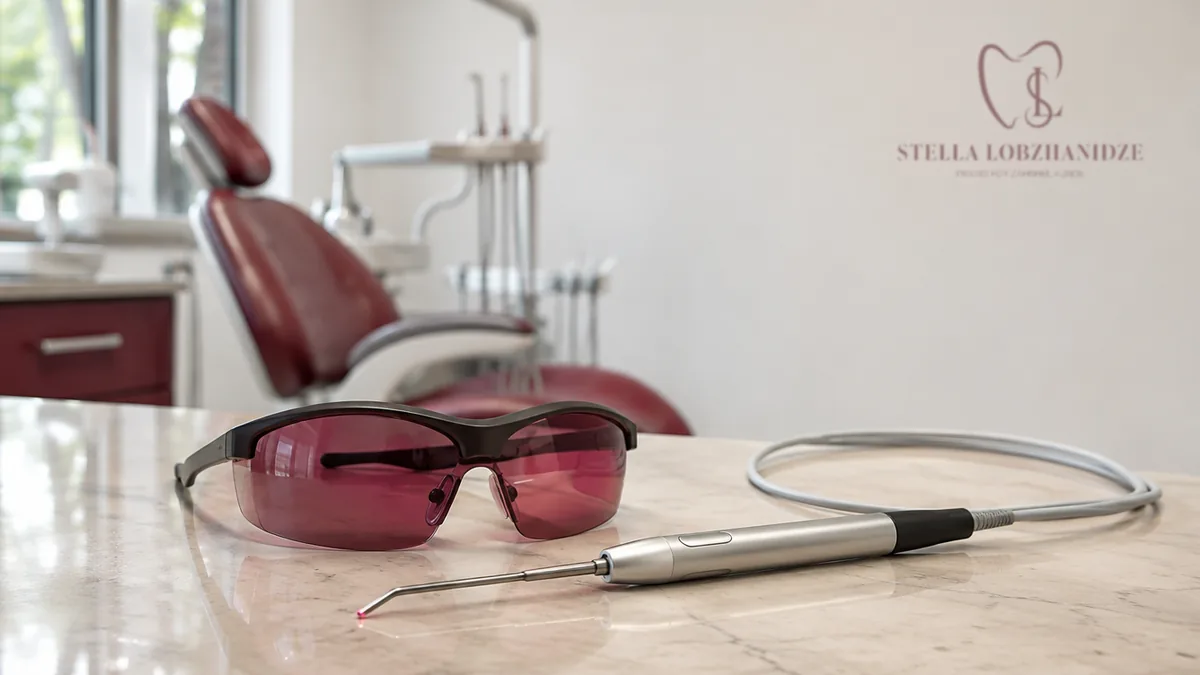
A dental laser focuses light of a specific wavelength. Different devices work differently. Some lasers can remove hard tooth tissue, while others act mainly through heat and are only suitable for soft tissue such as gums or mucous membranes.
A statement by the German Society of Dental, Oral and Craniomandibular Sciences (DGZMK) names, for example, treating certain mucosal diseases and surgery in people with bleeding disorders as established uses. For many other uses, the benefit was still unclear at that time. The statement dates from 1999, so some points may now be out of date.
Is laser treatment better than standard treatment for periodontitis?
Standard periodontitis treatment takes place in stages. First comes a professional dental cleaning and a discussion of risk factors. Then the gum pockets are cleaned mechanically. A check-up follows after about 6 to 12 weeks, and then regular aftercare.
The European S3 guideline on periodontitis looked at whether a laser helps in addition to pocket cleaning. Its conclusion: the evidence is not sufficient. It therefore suggests not using lasers as an add-on. The same applies to antimicrobial photodynamic therapy, which also uses light.
This does not mean that a laser causes harm. But thorough mechanical cleaning and your daily oral hygiene remain the foundation.
Do lasers make sense for tooth decay and fillings?
A Cochrane review compared lasers and drills for removing decay. With lasers, fewer people reported moderate or severe pain. Children and adolescents needed a local anaesthetic less often.
There was no difference in how long the fillings lasted after six months, one year and two years. However, the studies were small and of low quality. The authors therefore consider the evidence insufficient to recommend lasers as a replacement for the drill.
According to the DGZMK, preparing a tooth with a suitable laser also takes longer than with rotary instruments.
Does laser treatment hurt less?
Sometimes, but not always. For removing decay, studies point to less pain. Because the evidence is weak, no promise can be made on that basis.
Whether you need an anaesthetic depends on the treatment and on you. Speak openly if you are afraid of pain. Your dentist can then adapt the treatment.
Are there risks with laser treatment?
Lasers are medical devices with their own safety rules for patients and the dental team. The DGZMK points out possible risks:
- Lasers that work through heat are not suitable for hard tooth tissue.
- In gum pockets, the depth to which the light penetrates cannot be controlled precisely.
- Removing old fillings with a laser can release harmful fumes.
These points are one reason why every laser treatment should be checked to see whether it suits the individual case.
How can you tell whether laser treatment makes sense for you?
A laser makes sense when it offers an advantage for your specific treatment. These questions can help in the conversation:
- What exactly will the laser be used for?
- What would the standard treatment without a laser look like?
- What are the pros and cons of the laser in my case?
- What costs should I expect, and what will my health insurance cover?
Laser treatment in Vienna-Meidling: how do we proceed?
At our practice in 1120 Vienna-Meidling, we use a dental laser. Before every laser treatment, we check whether it suits your case. Afterwards, you get aftercare advice and a follow-up appointment.
Before every treatment, you receive a detailed cost estimate. For insurers other than SVS and KFA, we treat you as a Wahlärztin (private dentist), and we help you submit the bill. To book an appointment, call +43 1 813 31 23 or book online at stelladent.termin365.at.
Book an appointment
Book online or give us a call.
Sources
- Cochrane – Lasers for caries removal in deciduous and permanent teeth
- EFP – Treatment of stage I–III periodontitis: The EFP S3 level clinical practice guideline (J Clin Periodontol 2020)
- DGZMK – Wissenschaftliche Stellungnahme: Laseranwendung in der Zahnmedizin
- gesundheit.gv.at – Parodontitis
- gesundheitsinformation.de – Wie wird eine Parodontitis behandelt?
- gesundheit.gv.at – Zahnbehandlungsangst
This article is for general information only and does not replace a dental examination or advice.