Partial denture or fixed restoration: which is the better fit?
A partial denture is removable and is attached to your own teeth. A fixed restoration, such as a bridge or a crown on an implant, stays firmly in your mouth. Which is better depends mainly on how many teeth are missing and how stable the remaining ones are.
By Stela Lobzhanidze, dentist in Vienna-Meidling
Published
Key points
- A partial denture is usually an option when there are too few strong teeth to support a bridge.
- A bridge needs stable neighbouring teeth, which are usually reduced and crowned for this purpose.
- Implants can carry crowns, bridges or dentures.
- You take a partial denture out every day to clean it, and getting used to it often takes a few weeks.
- Fixed restorations are harder to clean but need less maintenance.
What is the difference between a partial denture and a fixed restoration?
A fixed restoration is firmly anchored in your mouth. This includes crowns, bridges and restorations on implants.
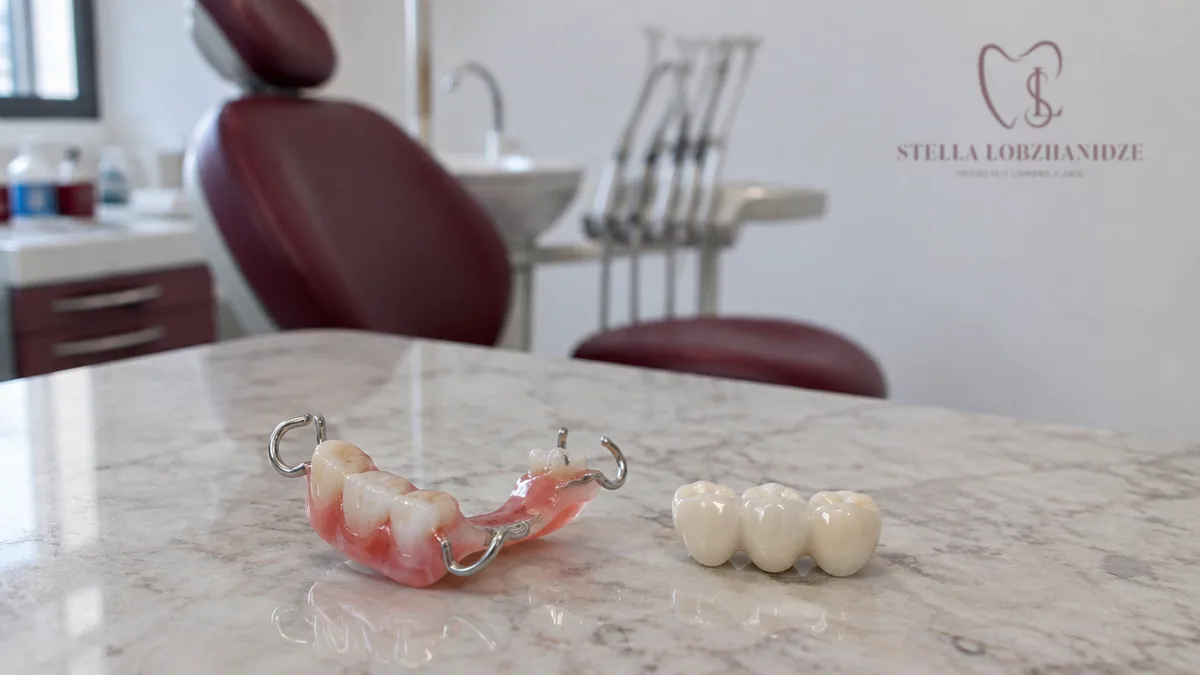
A partial denture is removable. It is made of plastic and metal and is attached, for example with clasps, to your own teeth or to implants. It is an option when several teeth are missing but some of your own teeth remain.
The two can also be combined, for example a crown on an implant with a partial denture attached to it.
What types of partial dentures are there?
Partial dentures differ mainly in how they hold on to your own teeth:
- Clasp denture: a metal framework carries the artificial teeth, and clasps grip the remaining teeth. The teeth hardly need to be reduced, but the clasps are partly visible.
- Telescopic denture: some teeth are reduced and fitted with metal caps onto which the denture fits. It holds firmly but puts a lot of strain on the anchor teeth.
- Attachment denture: the teeth receive crowns with a connecting element, and the matching part sits in the denture. It works without clasps, but the teeth have to be reduced more.
What are the pros and cons of a partial denture compared with a bridge?
A partial denture can replace many missing teeth at once. It can be cleaned outside the mouth and can often be extended or repaired.
On the other hand, it is a larger foreign body in the mouth and often covers part of the palate. Plaque easily builds up on the clasps, which increases the risk of decay and gum disease. On average, a repair is needed about every two years.
A bridge is fixed and does not need to be taken out. For a conventional bridge, however, the neighbouring teeth are reduced and crowned. For small gaps, an adhesive bridge with wings bonded to the neighbouring teeth is sometimes possible.
When is a fixed restoration possible without implants?
Bridges are more suitable for smaller gaps. They need sufficiently stable teeth to support them. If many teeth are missing or the possible support teeth are not stable enough, a partial denture usually makes more sense.
The opposing teeth, your oral health, your age and your lifestyle also play a part in the decision. So do your personal preferences, appearance and how easily you can put in and clean a denture.
Can a partial denture also be held by implants?
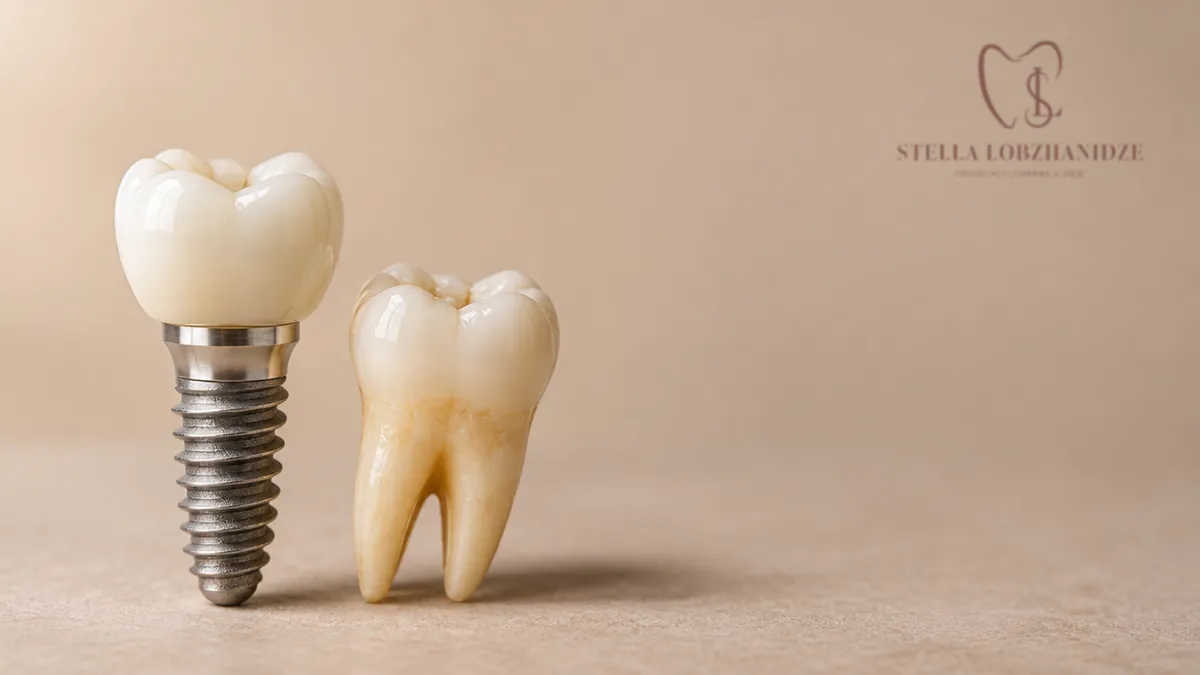
Yes. Implants are artificial tooth roots made of titanium or ceramic that are anchored in the jawbone. They can carry single crowns, bridges or dentures, so a partial denture can also be attached to implants.
Whether implants are an option for you, and whether your restoration can be supplemented with them, depends on your situation, for example on your remaining teeth and your jawbone. Your dentist will clarify this after an examination.
What is everyday life like with a partial denture?
Most people get used to a new denture within a few weeks. Practise putting it in and taking it out, and eat softer foods at first. Speaking also takes a little practice.
Take the denture out every day and clean it over a basin of water so that it does not break if you drop it. Also clean your own teeth and gums thoroughly. As a rule, the denture stays out at night unless your dentist advises otherwise.
Have pressure sores or inflammation checked promptly. A dental check-up at least once a year makes sense, because gums and jaw change over time.
What does health insurance pay, and how do we advise you?
At the Austrian health insurance fund ÖGK, removable dentures are subsidised if the application has been approved before the denture is made. Fixed restorations such as crowns, bridges or implants are in principle a private service there, except in certain medical special cases.
At our practice in 1120 Vienna-Meidling, we make partial and full dentures, crowns and bridges, and we place implants. Before every treatment you receive a detailed cost estimate, and we help you submit your claim. We bill SVS and KFA directly.
You can book an appointment on +43 1 813 31 23 or online at stelladent.termin365.at.
Come to the practice if:
- your denture presses or causes sore spots in your mouth
- the denture wobbles, slips or clicks when you speak
- the denture is broken; bring all the pieces with you
- the gum around the clasp teeth is red or bleeds
Book an appointment
Book online or give us a call.
Sources
- IQWiG – gesundheitsinformation.de: Welche Arten von Zahnersatz gibt es?
- KZBV – Patienteninfos: Teilprothesen
- gesundheit.gv.at – Zahnersatz: Kronen und Brücken
- NHS – Dentures (false teeth)
- ÖGK – Zahnersatz
- gesundheit.gv.at – Zahnimplantate
- ZQP und Bundeszahnärztekammer – Ratgeber Mundpflege (2022)
This article is for general information only and does not replace a dental examination or advice.