Closing a gap between your front teeth: what are the options?
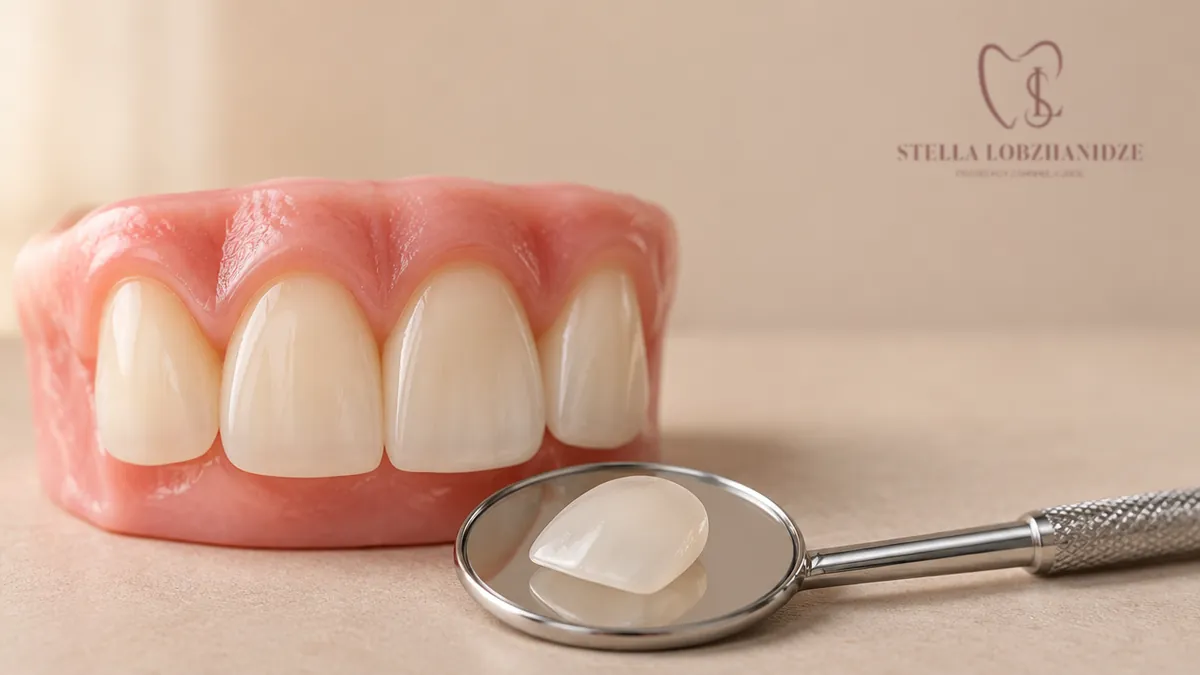
A gap between the upper front teeth is called a diastema and is usually harmless. Whether you have the gap closed is often a question of appearance. Options include composite build-ups, veneers or braces, depending on the size and cause of the gap.
By Stela Lobzhanidze, dentist in Vienna-Meidling
Published
Key points
- A diastema is a gap between the two upper central incisors.
- Causes include small teeth, a wide jaw or a low-attached lip frenum.
- A gap does not always need treatment as long as your bite and gums are healthy.
- Small gaps can be closed with composite or veneers; for larger ones, braces may be the better choice.
- If a new gap appears in adulthood, your gums should be checked.
How does a gap between the upper front teeth develop?
Gaps can appear even when all teeth are present. Common reasons are:
- teeth that are rather small in relation to the jaw
- a jaw that is relatively wide
- teeth that are missing from birth
- a low-attached upper lip frenum that pushes the central incisors apart
In adults, a new gap can also be a sign of disease of the tissues that support the teeth. With periodontitis, teeth lose their hold and can change position.
Does a gap always need treatment?
No. A bite can be healthy and work well even if it does not match an ideal of beauty. Slight irregularities are often purely cosmetic.
Some people are so bothered by a gap that they avoid smiling, and then wanting treatment is understandable. An examination comes first so that the cause is clear. If periodontitis is present, it is treated first.
How can a gap between the front teeth be closed?
Which method fits depends on the size of the gap, the shape of your teeth and your wishes. Options include:
- Composite: tooth-coloured resin is added directly to the teeth and makes them slightly wider. On teeth that have not been ground down, it can later be removed without damaging the tooth.
- Veneers: thin ceramic shells on the front of the teeth can close small gaps and change shape or colour at the same time. Usually a little enamel is removed for this.
- Braces: they move the teeth themselves and close the gap without changing the teeth.
- Frenum procedure: if a low-attached frenum is the cause, it can be repositioned surgically.
Can braces close the gap in adults too?
Yes. Misaligned individual teeth can often be corrected well in adulthood too. It is more difficult if the whole jaw is affected or the gums are not healthy.
Besides fixed braces, there are clear removable trays known as aligners. Treatment usually takes longer than a composite build-up. It is followed by a retention phase so that the teeth do not drift back. Planning and treatment are carried out by an orthodontist.
Does health insurance pay to treat a gap?
Purely aesthetic treatments such as veneers are generally not covered by health insurance. Insurers are also cautious about braces for adults. In Germany, for example, statutory insurers generally only pay for treatment starting after the 18th birthday in cases of severe jaw problems.
Your insurer can tell you what applies in your case in Austria. It is best to ask before treatment starts.
How do we advise you in Vienna-Meidling?
At our practice in 1120 Vienna we take a close look at the gap, your teeth and your gums. We offer ceramic veneers, for which we remove only a very small amount of the tooth surface, about 0.3 to 0.7 millimetres. After the examination we discuss with you whether veneers, a composite build-up or braces make more sense in your case.
You receive a cost estimate before any treatment. You can book online at stelladent.termin365.at or by phone on +43 1 813 31 23.
Come to the practice if:
- a new gap appears between your teeth or an existing gap gets bigger
- teeth become loose or change position
- a gap bothers you and you want to know which treatment suits you
Book an appointment
Book online or give us a call.
Sources
- KZBV – Häufige Fehlstellungen
- gesundheitsinformation.de – Wie sehen Zahn- und Kieferfehlstellungen aus?
- BARMER – Kieferorthopädie: Wann eine Zahnspange sinnvoll ist
- Verbraucherzentrale – Veneers: Korrektur bei leichten Zahnfehlstellungen
- gesundheit.gv.at – Parodontitis
- gesundheit.gv.at – Zahn- und Kieferfehlstellungen
- gesundheit.gv.at – Zahnspangen und Zahnschienen
This article is for general information only and does not replace a dental examination or advice.