Replacing old fillings: when is it necessary?
Replacing old fillings makes sense when a filling is damaged or leaking, or when decay develops underneath it. An intact filling, including an amalgam one, does not need to be replaced without a reason. Regular check-ups show whether a filling is still in good condition.
By Stela Lobzhanidze, dentist in Vienna-Meidling
Published

Key points
- Fillings are replaced when they are broken, leaking or affected by new decay.
- Pain or sensitivity to cold, heat or acidic food can be a sign of a leaking filling.
- Since 1 January 2025, amalgam has generally no longer been used for new fillings in the EU.
- Intact amalgam fillings do not have to be removed; drilling them out can release mercury.
- On average fillings last many years, depending on the material, their size and your oral hygiene.
When does an old filling need to be replaced?
A filling is renewed when it is damaged or no longer does its job for another medical reason. This is the case, for example, when:
- the filling has broken, cracked or fallen out
- a gap has formed between the filling and the tooth
- new decay has developed at the edge of the filling
An intact filling that causes no problems, on the other hand, does not need replacing.
How can you tell that a filling should be replaced?
You may notice some signs yourself, such as toothache or sensitivity to hot, cold or acidic food. These can indicate that a filling is leaking.
Often, though, a problem is only found at a check-up. That is why it makes sense to have your fillings checked regularly by a dentist, even when nothing hurts.
What happens if an old filling is leaking?
Composite fillings shrink slightly as they harden, which can leave tiny gaps at the edge.
Bacteria settle in such gaps and new decay can develop, known as secondary caries. Placing the filling in several thin layers reduces this risk. If a filling is already leaking, it should be replaced.
Do I need to have my amalgam fillings removed?
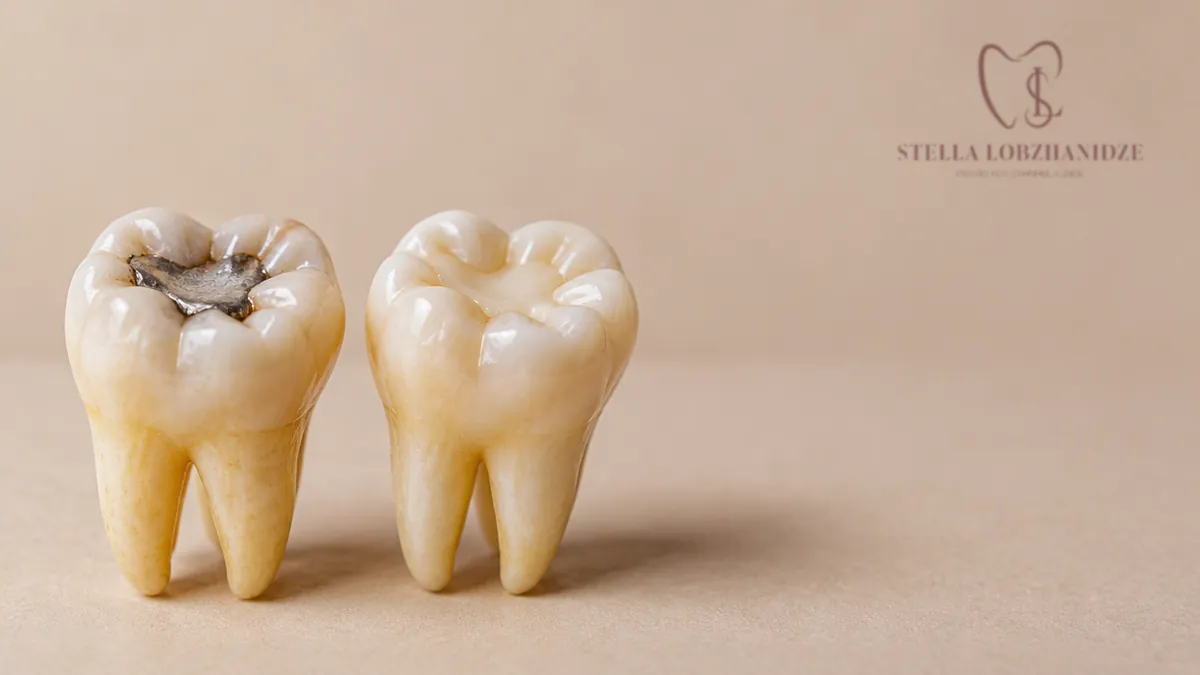
No, not as long as they are intact. Since 1 January 2025, amalgam may generally no longer be used for dental treatment in the EU. The only exceptions are cases where it is strictly necessary for medical reasons. The ban is mainly intended to protect the environment and was not introduced for health reasons.
Existing amalgam fillings do not need to be replaced. Removing them can release mercury, so intact fillings should not be drilled out without a reason. If an amalgam filling is damaged, it is replaced with a different material.
How long do fillings last on average?
According to a patient information leaflet from the German dental associations, fillings in back teeth that take chewing pressure last roughly this long on average:
- composite: eight to ten years
- amalgam: eight to twelve years
- ceramic inlays: ten to 15 years
- glass ionomer cement: one to two years, as it serves more as an interim solution
These are statistical figures. How long your filling lasts depends on its size, its position and your oral hygiene. Grinding your teeth and frequently chewing very hard food wear fillings down faster.
Which material can be used for the replacement?
Small and medium defects can be filled with tooth-coloured composite. For larger defects in back teeth, a ceramic inlay can support the tooth better. The choice depends on the size and position of the defect and is made together with you.
What your health insurer covers depends on the material, the tooth and your insurer. If in doubt, ask before treatment.
How do we work at our practice?
At our practice in 1120 Vienna-Meidling we check your fillings at your check-up. To detect decay between the teeth we can also use the DIAGNOcam, which works without X-rays.
We place fillings in tooth-coloured composite, layer by layer. For larger defects we have ceramic inlays made in a dental laboratory. You receive a cost estimate in advance. You can book online at stelladent.termin365.at or call +43 1 813 31 23.
Come to the practice if:
- a filling has fallen out, broken or cracked
- a filled tooth is sensitive to cold, heat or acidic food
- a tooth with a filling hurts
- your last check-up was more than a year ago
Book an appointment
Book online or give us a call.
Sources
- KZBV – Welche Zahnfüllungen gibt es?
- BARMER – Zahnfüllung: Welche ist die richtige?
- EUR-Lex – Verordnung (EU) 2024/1849 zur Änderung der Verordnung (EU) 2017/852 über Quecksilber
- DGZMK/KZBV – Patienteninformation Zahnärztliche Füllungsmaterialien
- gesundheit.gv.at – Zahnfüllungen
- ÖGK – Amalgam: FAQs
- Österreichische Zahnärztekammer – Infoblatt Amalgamverbot ab 1. Jänner 2025
This article is for general information only and does not replace a dental examination or advice.