Teeth whitening at the dentist or at home: what is the difference?
With teeth whitening at the dentist, or at home with trays made by your dentist, effective gels are used under professional supervision. Products sold freely vary widely in how well they work and are used without a prior check-up. Teeth and gums should be examined before any whitening.
By Stela Lobzhanidze, dentist in Vienna-Meidling
Published
Key points
- At the practice and with home whitening using custom trays, stronger gels are used under a dentist's supervision.
- Products from shops or the internet may contain no more than 0.1 percent hydrogen peroxide, and how well they work varies widely.
- The most common side effect is temporary tooth sensitivity.
- Crowns, fillings and veneers do not become lighter with whitening.
- Whitening counts as a cosmetic treatment and is not reimbursed by Austrian social insurance.
Teeth whitening at the dentist or at home: which methods are there?
Whitening works with hydrogen peroxide or carbamide peroxide. The active ingredient lightens pigments in the tooth enamel. There are roughly three options:
- Whitening at the practice: the gums are covered, then a gel is applied and often activated with light. Depending on the starting shade, one or more appointments are needed.
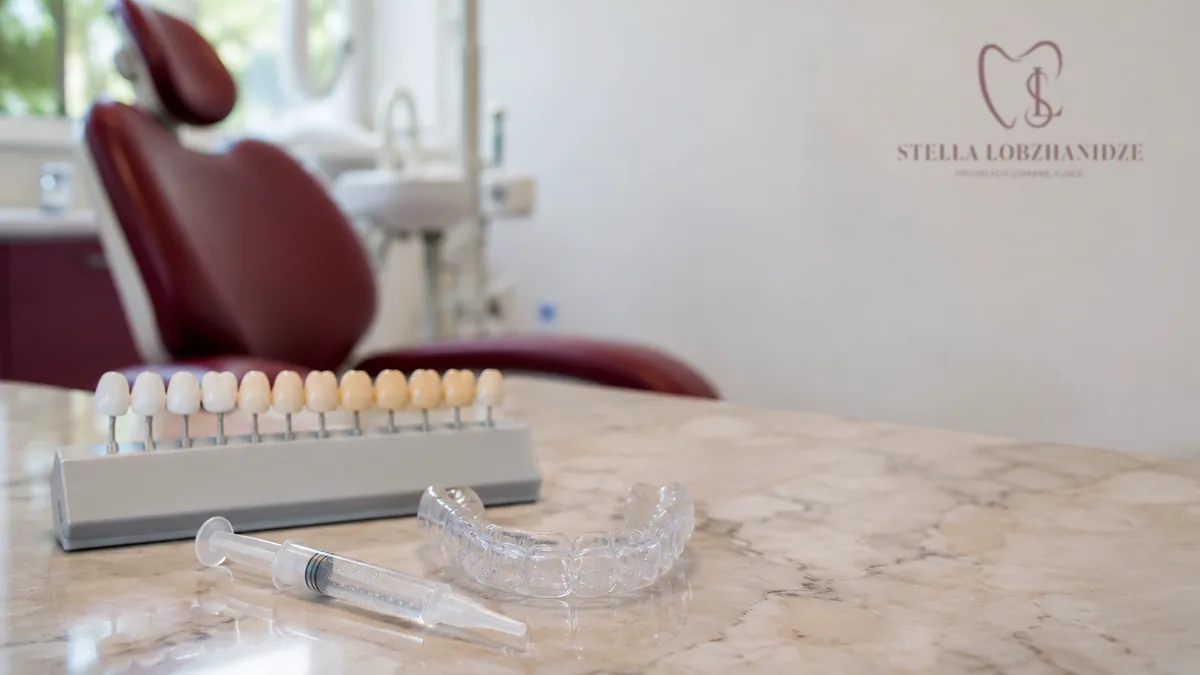
- Home whitening with trays: the practice makes trays that fit your teeth. You wear the gel at home as instructed, depending on the product for a few hours a day or overnight, usually for two to three weeks.
- Products sold freely: strips, pens or ready-made trays from shops or the internet. They may contain no more than 0.1 percent hydrogen peroxide. How well they work varies widely.
If a single root-filled tooth has turned dark, whitening from the outside does not help. The tooth can then be lightened from the inside.
Who may whiten teeth in Austria?
In the view of the Austrian Dental Chamber, tooth whitening is a dental treatment. It requires an examination, a diagnosis, a consultation about risks and a professional teeth cleaning beforehand.
The chamber has therefore taken legal action against offers in beauty, nail and tanning salons. In Germany, the German Dental Association takes the same position.
Are whitening products from shops and the internet a concern?
Their effect varies widely. In a 2026 test by the Austrian consumer association VKI, some products whitened clearly, others barely. According to the German Dental Association, they can damage teeth and gums, especially if there is undetected decay or a leaking filling.
If a tray fits poorly or the dose is not accurate, the gel can irritate and inflame the gums.
Whitening toothpastes usually work with abrasive particles. They remove surface stains, but regular use can roughen the enamel. The German Dental Association also says home remedies such as baking soda usually give only moderate results.
Do teeth become sensitive after whitening?
This is the most common side effect. The teeth then react more strongly to cold, heat or touch for a while. The gums can also be briefly irritated.
Based on current knowledge, no lasting damage is expected if the product is used correctly. However, long-term effects of repeated use are still being studied.
If you get severe pain, stop whitening and contact your dental practice.
Who is whitening not suitable for?
Whitening is not advised, or should be postponed, if:
- you have tooth decay, gum inflammation or periodontitis
- fillings or crown edges are leaking
- tooth necks are exposed or your teeth are already very sensitive
- you are pregnant or breastfeeding
- you are under 18
- you are known to be allergic to ingredients in the gel
Visible fillings, crowns or veneers keep their shade. After whitening, there may be a colour difference that could make replacing them later necessary.
Does health insurance pay for teeth whitening?
No. Whitening counts as a cosmetic treatment and is not reimbursed by Austrian social insurance.
The cost depends on the method and the effort involved. Ask for a cost estimate beforehand.
How does whitening work at our practice?
At our practice in 1120 Vienna-Meidling, we first examine your teeth. Then we apply a whitening gel and activate it with light while your gums are protected. The treatment takes about one hour.
We also offer home whitening with custom-made trays. Before any treatment you receive a cost estimate. Book an appointment on +43 1 813 31 23 or online at stelladent.termin365.at.
Come to the practice if:
- you want to whiten your teeth and have decay or leaking fillings ruled out first
- you get severe or lasting pain after whitening
- your gums are red or inflamed after using a home product
- only a single tooth has turned dark
Book an appointment
Book online or give us a call.
Sources
- Bundeszahnärztekammer – Bleaching (Zahnaufhellung)
- Bundeszahnärztekammer – Zähnebleichen (Bleaching) ist eine zahnärztliche Leistung
- Verbraucherzentrale – Bleaching: Möglichkeiten der Zahnaufhellung
- Landeszahnärztekammer Oberösterreich – INDENT 01/2020: Zahnaufhellung durch Nicht-Zahnärzte
- gesundheit.gv.at – Zahnverfärbungen
- VKI – Mittel zur Zahnaufhellung: Test (Presseaussendung, Mai 2026)
- NHS – Teeth whitening
This article is for general information only and does not replace a dental examination or advice.