Immediate implant: who is it suitable for?
An immediate implant is placed in the same appointment in which the tooth is removed. This only works if your bone, gums and general health are suitable and the implant is firmly anchored in the bone straight away. Often it makes more sense to wait a few weeks or months.
By Stela Lobzhanidze, dentist in Vienna-Meidling
Published
Key points
- With immediate placement, the implant goes in on the day the tooth is removed, usually at the same visit.
- The implant must be stable in the right position straight away, and there must be no major bone defects.
- With acute inflammation, untreated gum disease, poorly controlled diabetes or certain medicines, a later implant is usually preferred.
- In studies, immediate implants for single teeth fail slightly more often than implants placed later.
- Whether you get a fixed tooth straight away or a temporary one first is decided case by case.
What is an immediate implant?
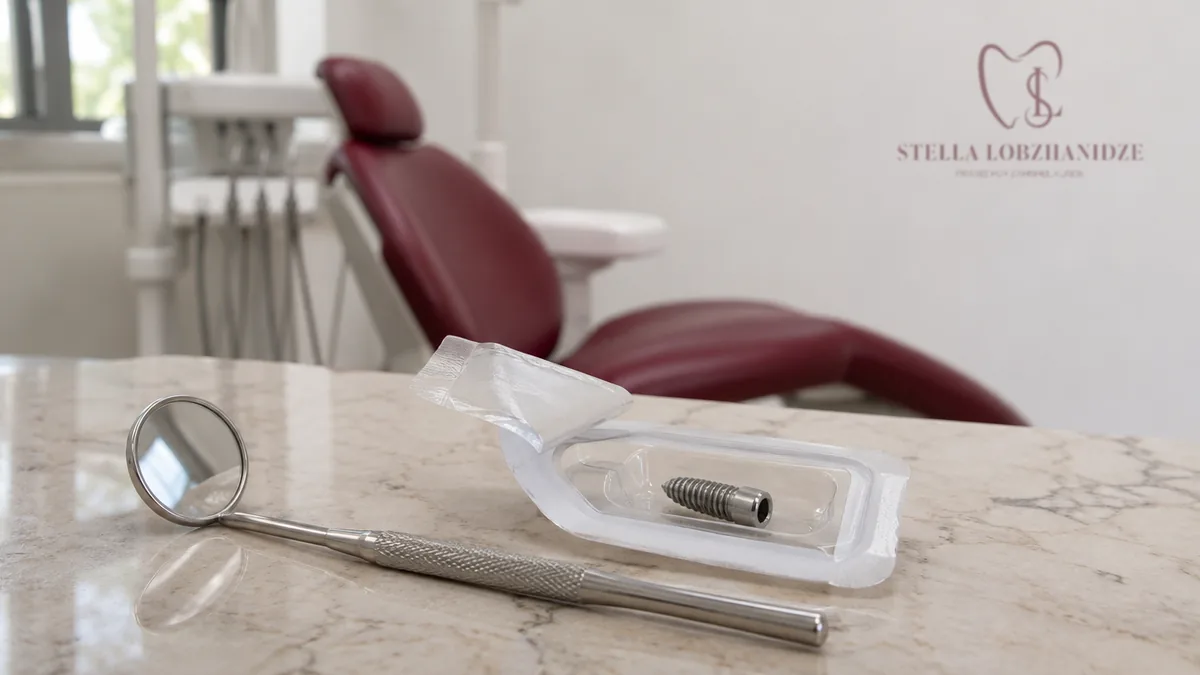
An implant is an artificial tooth root anchored in the jawbone. Later it carries a crown, a bridge or a denture. The German guideline on implant timing distinguishes between several points in time after a tooth is removed:
- Immediate placement: on the day of the extraction, usually in the same session
- Early placement: after about 4 to 8 weeks, once the gum has healed, or after 12 to 16 weeks, once some of the bone has grown back
- Late placement: after more than 16 weeks, once the bone has healed
Placing the implant at the same visit is the exception rather than the rule. More often the tooth is removed a few weeks beforehand so that the gum can heal first.
Who is an immediate implant suitable for?
According to the guideline, the decision is made individually in every case and after careful consideration. Conditions are favourable if:
- the implant holds firmly in the bone in the correct position straight away
- the bone wall on the outer side of the tooth socket is intact and not too thin
- the gum tissue is fairly thick
- there is no acute inflammation at the site
- any gum disease in the rest of the mouth has been treated
As with any implant, your general health, smoking and the condition of your teeth, gums and jawbone also matter. A thorough X-ray examination is needed before the procedure.
When is an immediate implant not recommended?
In some situations the guideline recommends waiting, or looking especially critically at immediate placement:
- larger bone defects that stop the implant from holding firmly
- acute inflammation around the tooth that is being removed
- poorly controlled diabetes
- previous radiotherapy to the head and neck, or medicines that slow down bone loss, such as bisphosphonates
In the front of the mouth, the risk of a poor appearance is high if both bone and gum tissue are missing. Smoking also increases the risk of losing an implant later on.
What are the risks of an immediate implant?
Immediate placement is considered technically demanding. Research reviews show that, for single teeth, immediate implants survive slightly less often than implants placed after a few weeks or months. The difference is small but measurable.
If the gum or the bone wall is thin, the gum on the outer side can recede. This is especially noticeable at the front of the mouth.
On top of this come the general risks of any implant: a wound infection, an implant that does not bond with the bone, or later inflammation with bone loss that can make the implant loose.
Do you get a tooth straight away or a temporary one?
An immediate implant does not automatically mean the final crown is fitted the same day. In some cases a replacement tooth can be attached straight away. However, the guideline lists this immediate restoration as an additional risk factor and recommends close follow-up.
Often a temporary solution covers the healing period, for example a small removable denture. A temporary tooth on the implant is often made slightly shorter so that it is not loaded when you chew.
The bone usually needs two to six months to bond firmly with the implant. Your dentist will tell you how long you should chew carefully on that side.
How do we advise you at our practice in Vienna?
At our practice in 1120 Vienna-Meidling, we place implants after an examination and a treatment plan, usually under local anaesthetic. For planning, we have a CBCT (DVT) unit for three-dimensional images of the jaw and bone.
After the examination we discuss with you whether an immediate implant or a later date is better for you. Before treatment you receive a detailed cost estimate.
You can book an appointment on +43 1 813 31 23 or online at stelladent.termin365.at.
Come to the practice if:
- a tooth can no longer be saved and you would like to know whether an implant is an option
- pain or swelling after the procedure has not eased after a week
- the temporary tooth or the implant feels loose
- the gum around the implant bleeds, looks red or is swollen
See a dentist or the emergency service straight away if:
- bleeding does not stop even though you have bitten firmly on a clean cloth for 30 minutes
- swelling reaches your eye or neck, or you find it hard to breathe or swallow
Outside opening hours, you can reach the dental emergency service on +43 1 512 20 78
Book an appointment
Book online or give us a call.
Sources
- DGI / DGZMK – S2k-Leitlinie Implantationszeitpunkte (2022)
- gesundheit.gv.at – Zahnimplantate
- Leeds Teaching Hospitals NHS Trust – Dental implants
- Guy's and St Thomas' NHS Foundation Trust – After having a dental implant
- NHS – Toothache
- rauchfrei.at (ÖGK) – Rauchen und Mundgesundheit
- AWMF / DGI – S3-Leitlinie Zahnimplantate bei medikamentöser Behandlung mit Knochenantiresorptiva (2026)
This article is for general information only and does not replace a dental examination or advice.