Bone grafting before a dental implant: when is it needed?
Bone grafting is needed when the jawbone is too narrow or too low for an implant. If only a little bone is missing, it is often rebuilt during the same procedure as the implant. With larger defects, bone grafting is done months beforehand, and treatment takes longer.
By Stela Lobzhanidze, dentist in Vienna-Meidling
Published
Key points
- After a tooth is lost, the jawbone shrinks, most of all in the first months.
- An implant needs enough bone all around it, in both height and width.
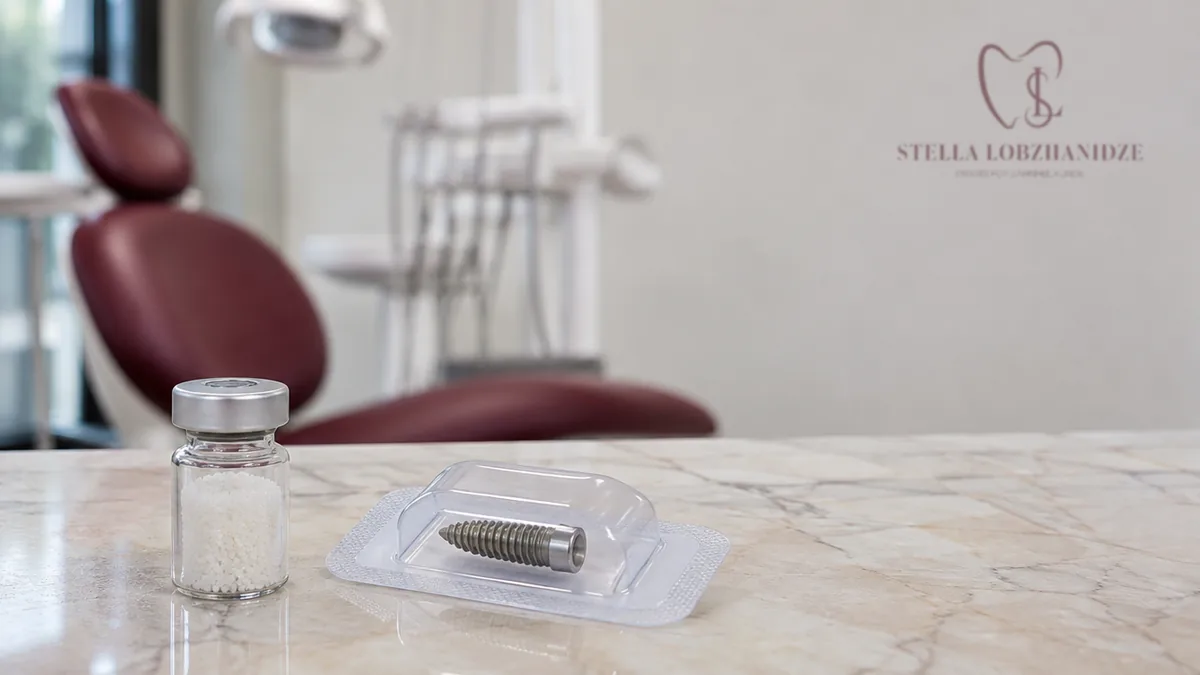
- Grafting uses your own bone, a bone substitute or both.
- Small grafts are often done in the same procedure as the implant, larger ones months beforehand.
- In the upper jaw, a sinus lift can create more bone height.
Why is bone grafting sometimes needed before an implant?
An implant must sit firmly in the jawbone. For this, there needs to be enough bone all around it.
After a tooth is removed, the bone shrinks, especially in width. The loss is greatest in the first three to six months. If a gap is left for a long time, a lot of bone can be lost.
X-rays show whether there is enough bone. A three-dimensional scan, for example with a CBCT (DVT), is often helpful.
How does bone grafting for an implant work?
How extensive the procedure is depends on how much bone is missing:
- With small defects, bone is added when the implant is placed. Bone chips from the surrounding area or a substitute material are placed there and covered with a thin membrane.
- With medium defects, the bone is built up a few months before the implant.
- With large defects, a block of bone is used, for example from the chin area or the hip. Some larger procedures of this kind are done under general anaesthetic in hospital.
If a tooth has to be removed, your dentist can treat the socket so that as much bone as possible is preserved. This is called ridge preservation.
Can bone grafting and the implant be done in one session?
Yes, if only a little bone is missing. The implant is placed and the bone added in the same operation.
When an implant is placed straight after a tooth is removed, bone is often added at the same time, for example if the outer bone wall is very thin or a larger gap remains between the implant and the bone.
With larger defects, treatment is usually done in two steps: first the bone graft, then the implant once it has healed.
What is a sinus lift?
In the upper jaw, the maxillary sinuses lie above the back teeth. They can limit the space for an implant.
In a sinus lift, bone is built up under the floor of the sinus. This creates more height in which the implant can anchor. X-ray planning shows whether this is necessary in your case.
What is the material for bone grafting made of?
Your own bone, a bone substitute or a combination of both is used.
Your own bone is usually taken near the surgical site in the mouth, or from the chin or hip for large defects. Substitute material can be of animal origin, for example. A thin membrane is usually placed on top.
Your dentist will explain which material suits your case before the procedure.
How long does healing take, and does bone grafting hurt?
Bone grafting makes treatment more complex and longer. The implant is usually placed a few months after the graft. After that, the implant itself usually needs another two to six months to heal.
The procedure is usually done under local anaesthetic. Afterwards, swelling, bruising and pain for a few days are common. Antibiotics are more likely to be given with bone grafting than with a simple implant.
Smoking and poorly controlled diabetes increase the risk of complications. Mention both openly beforehand.
How do we plan bone grafting and implants in Vienna?
At our practice in 1120 Vienna-Meidling, we have a CBCT (DVT) unit for three-dimensional images of teeth, jaw and bone. This is especially helpful for planning implants and surgical procedures. The radiation dose is much lower than with a CT scan.
Dentist Stela Lobzhanidze discusses with you whether bone grafting is needed and what the timeline looks like. Before treatment, you receive a detailed cost estimate. You can book on +43 1 813 31 23 or online at stelladent.termin365.at.
Come to the practice if:
- you have a missing tooth and would like an implant later
- a tooth is due to be removed and you are considering an implant
- swelling or pain gets worse rather than better a few days after the procedure
See a dentist or the emergency service straight away if:
- bleeding after the procedure does not stop even though you have bitten firmly on a clean, rolled-up cloth for at least 30 minutes
- you have very severe pain, increasing swelling or a fever
Outside opening hours, you can reach the dental emergency service on +43 1 512 20 78
Book an appointment
Book online or give us a call.
Sources
- Leeds Teaching Hospitals NHS Trust – Dental implants
- gesundheit.gv.at – Zahnimplantate
- DGZMK / DGI – S2k-Leitlinie Implantationszeitpunkte (2022)
- Guy's and St Thomas' NHS Foundation Trust – After having a dental implant
- rauchfrei.at (ÖGK) – Rauchen und Mundgesundheit
- DGZMK – S2k-Leitlinie Dentale digitale Volumentomographie (2022)
This article is for general information only and does not replace a dental examination or advice.