Decay between the teeth: spotting, treating and preventing it
Decay between the teeth develops where a toothbrush hardly reaches. It does not hurt for a long time and is hard to see with the naked eye. That is why cleaning between your teeth every day and regular check-ups matter.
By Stela Lobzhanidze, dentist in Vienna-Meidling
Published
Key points
- The spaces between the teeth make up about a third of the tooth surface, and a toothbrush alone often does not clean them thoroughly.
- Decay between the teeth starts without pain and therefore often goes unnoticed for a long time.
- It can be made visible with an X-ray or by shining light through the tooth.
- Early decay without a hole can heal again; a cavity needs a filling.
- Floss or interdental brushes help prevent decay between the teeth.
Why does decay often develop between the teeth?
Caries develops when bacteria in plaque break down sugar and produce acids. These acids attack the tooth enamel.
Food debris and plaque collect particularly easily between the teeth. These spaces make up about a third of the entire tooth surface. A toothbrush alone often does not get them properly clean, whether you use a manual or an electric one.
Dentists call decay in these areas approximal caries.
Which teeth are affected most often?
In children, decay between the teeth often appears first in the baby molars. According to a paediatric dentist interviewed in the German dental journal Zahnärztliche Mitteilungen, the contact point between the first and second baby molars is almost always affected first.
The reason: the enamel of baby teeth is thin, and even thinner at this spot. In addition, the contact area between these two teeth tends to get wider over time, while other gaps often open up a little by themselves.
In adults, decay can in principle develop in any space between the teeth. With age, decay on exposed tooth necks and roots becomes more common.
How can you tell if you have decay between your teeth?
You often notice decay between the teeth yourself only late. At first it does not hurt. The first signs are rough white spots in the enamel, and here they are in a place you cannot see in the mirror.
Later, these signs may appear:
- the tooth is sensitive to cold, hot or sweet things
- you feel a sharp pain when eating or drinking
- brown or dark spots appear on the tooth
- you have toothache
Symptoms like these usually mean the decay has already progressed. In that case, do not wait until your next check-up.
Why is decay between the teeth often found late?
Because the contact point is hidden, looking into the mouth is often not enough here. An X-ray shows whether there is decay between the teeth and how far it goes.
A radiation-free option is transillumination with near-infrared light. It mainly reveals decay between the teeth and can be repeated as often as needed. However, it does not show the tooth nerve. With deep decay, an X-ray may therefore still be necessary.
Can decay between the teeth heal without a filling?
In the early stage, yes. As long as the decay only affects the enamel and no hole has formed, it can heal again. Fluoride gel or varnish helps return minerals to the tooth. For mild forms there is also caries infiltration, which hardens the enamel with a resin.
According to experts in Munich, if the decay has not yet reached the border between enamel and dentine, preventive measures are enough.
If a hole has already formed, the tooth needs a filling. Left untreated, the decay goes deeper and can reach the nerve.
Is brushing enough, or do you need floss?
Brushing alone is usually not enough for the spaces between the teeth. Here is how to prevent decay:
- Brush at least twice a day with fluoride toothpaste. Spit out afterwards without rinsing.
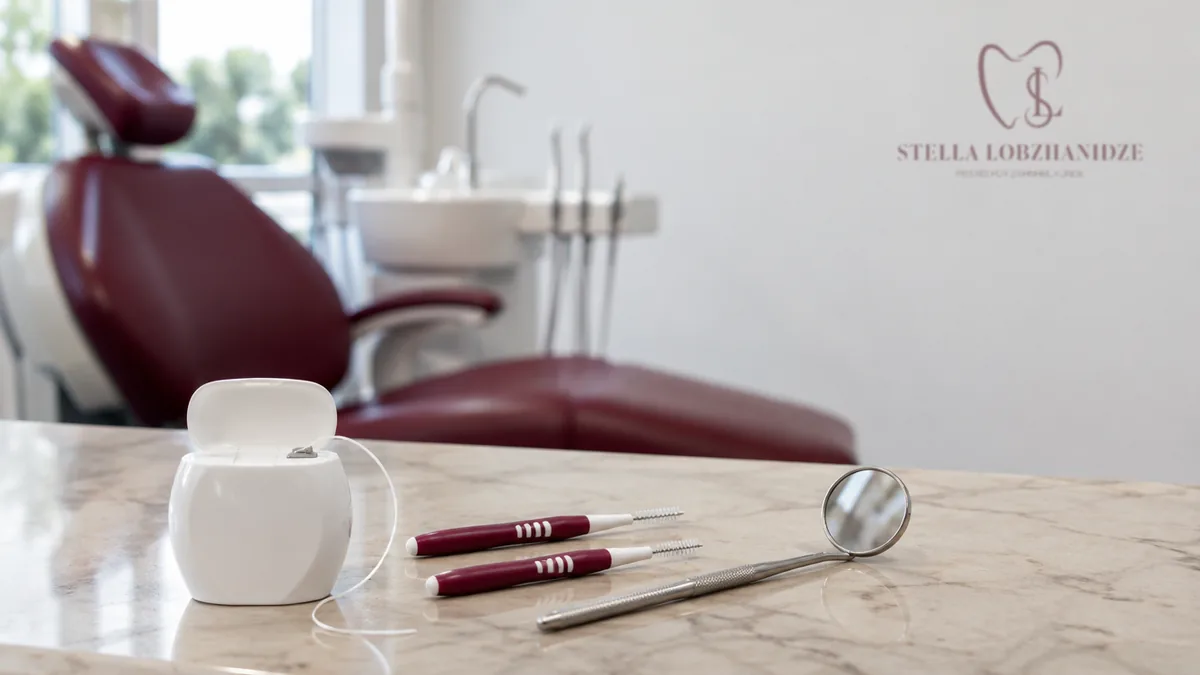
- Clean between your teeth every day with floss or interdental brushes.
- Have sugary food and drinks less often.
- Have your teeth checked at least twice a year.
Our team can show you which aids suit the gaps between your teeth.
What happens at a check-up at our practice?
At our practice in 1120 Vienna-Meidling, we can make decay between the teeth visible with the DIAGNOcam, without X-ray radiation. You can see the images directly on the screen.
If a tooth needs a filling, we remove the decay under local anaesthetic and fill the tooth layer by layer with tooth-coloured composite. Each layer is hardened with light.
We recommend a check-up and professional teeth cleaning twice a year, or more often if your risk of decay is higher. You can book online at stelladent.termin365.at or call +43 1 813 31 23.
Come to the practice if:
- a tooth is sensitive to cold, hot or sweet things
- you have sharp pain when eating or drinking
- you see brown or dark spots on a tooth
- your gums are painful, swollen or bleed when you brush
Book an appointment
Book online or give us a call.
Sources
- Gesundheitsportal (gesundheit.gv.at) – Karies: Was ist das?
- NHS – Tooth decay
- Landeszahnärztekammer Baden-Württemberg – Patienteninformation Prophylaxe
- Zahnärztliche Mitteilungen (zm) – Der Vierer distal ist entscheidend
- Zahnärztliche Mitteilungen (zm) – Leuchten statt Strahlen
- Österreichische Zahnärztekammer – Mundhygiene für zu Hause: 12 Tipps
- gesundheitsinformation.de (IQWiG) – Karies
This article is for general information only and does not replace a dental examination or advice.