Ceramic inlay or composite filling: what is the difference?
Whether a ceramic inlay or a composite filling is right for you depends mainly on the size of the defect. Small and medium cavities can be filled well with composite directly in the mouth. For larger defects in back teeth, a ceramic inlay made in a laboratory can support the weakened tooth better.
By Stela Lobzhanidze, dentist in Vienna-Meidling
Published

Key points
- A composite filling is placed in the tooth while soft and hardens there, usually in one visit.
- A ceramic inlay is made in a laboratory from an impression or scan and bonded in at a second visit.
- Inlays are mainly suitable for larger defects when enough strong tooth structure is left.
- Ceramic keeps its colour, while composite is more likely to stain and wear over the years.
- How long either lasts depends a lot on the size of the filling, how it is placed and your oral hygiene.
What is the difference between a ceramic inlay and a composite filling?
A white filling is made of composite, a tooth-coloured material of plastic resin and very fine glass particles. After the decay has been removed, it is placed in the tooth while soft and hardened with light. Composite is used on both front and back teeth.
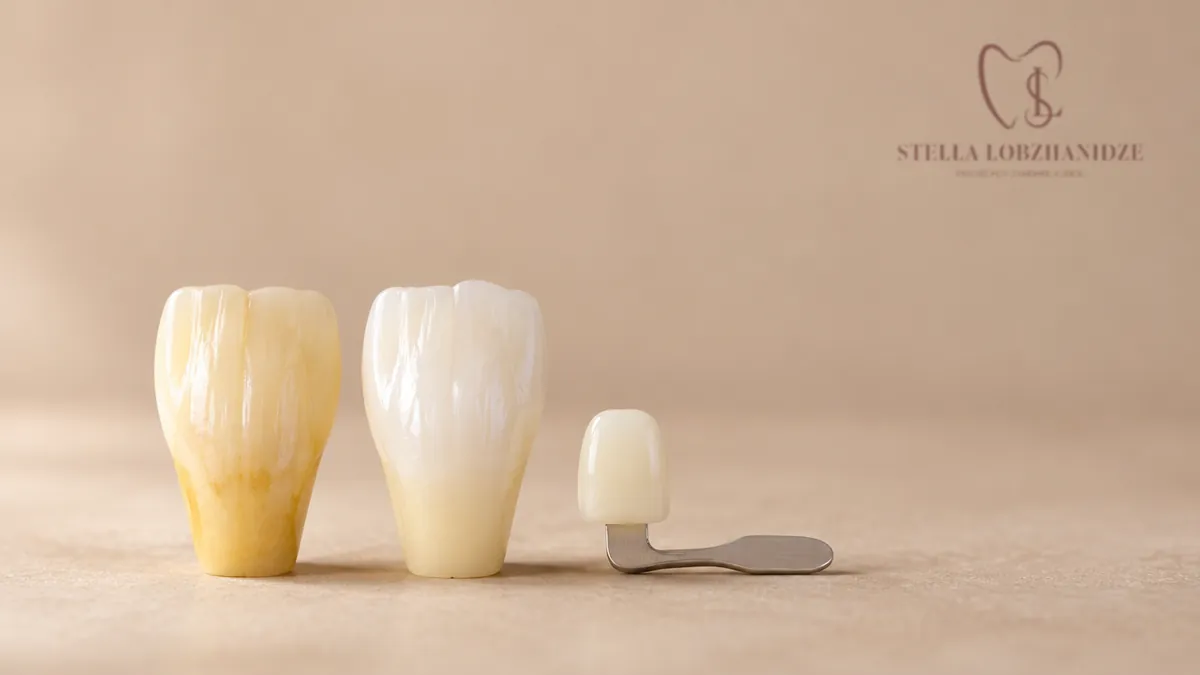
An inlay is an indirect filling. It is made to fit outside the mouth and then bonded into the tooth. Ceramic inlays are tooth-coloured and are fixed with a special resin adhesive. If the restoration extends over the cusps, it is called an onlay or overlay.
When is an inlay recommended instead of a normal filling?
A ceramic inlay is mainly an option for larger defects in back teeth. It supports weakened tooth walls and withstands chewing pressure well.
The condition is that enough healthy tooth structure remains after the decay has been removed. If the tooth is too badly damaged, a partial crown or crown is more likely to be needed. The line between these treatments is fluid.
For smaller cavities, a composite filling is usually the simpler solution. Discuss with your dentist which material suits you. Sometimes this only becomes clear during treatment.
How does each treatment work?
For a composite filling, the decay is removed and the material is placed in several thin layers. Each layer is hardened separately. This takes more effort but reduces tiny gaps at the edge where new decay can form.
A ceramic inlay usually needs two appointments:
- The decay is removed and the tooth is prepared.
- An impression or digital scan of the tooth is taken.
- A temporary filling protects the tooth until the inlay is ready.
- At the second appointment the inlay is fitted and firmly bonded in place.
How long does a composite filling last compared with an inlay?
According to a patient information leaflet from the German dental associations, composite fillings in back teeth last eight to ten years on average and ceramic inlays ten to 15 years. The Techniker Krankenkasse points out, however, that long-term experience with ceramic inlays is still limited.
These figures are averages. How long a filling lasts in your case depends on its size, the bonding technique and your oral hygiene.
What are the pros and cons of the two materials?
Ceramic keeps its colour, is considered well tolerated, does not conduct heat or cold and does not affect taste. However, an inlay can break under heavy load or if it is too thin. It cannot be repaired in the mouth, and making it takes more work than a filling.
Composite is finished in one visit and can be matched well to your tooth colour. Over the years, though, it is less resistant to wear and less colour-stable than ceramic, so composite fillings can discolour over time.
Does health insurance pay for a ceramic inlay?
With the ÖGK, composite fillings in front teeth and canines are a contract benefit. What your insurer covers for back teeth and for inlays depends on the material and on the rules of your insurer. If in doubt, ask your health insurer before treatment.
How do we treat you in Vienna-Meidling?
At our practice in 1120 Vienna we offer both. We place fillings under local anaesthetic using tooth-coloured composite, layer by layer, and polish them at the end. For larger defects, ceramic inlays made of all-ceramic material are custom-made in a dental laboratory and bonded in place.
You receive a cost estimate before any treatment. We bill SVS and KFA directly; for other insurers we work as a private-choice dentist (Wahlärztin). You can book online at stelladent.termin365.at or call +43 1 813 31 23.
Come to the practice if:
- a tooth is sensitive to cold, heat or acidic food
- a filling has broken, cracked or fallen out
- a filled tooth hurts when you chew
- you have a large old filling and want to know whether an inlay might be an option
Book an appointment
Book online or give us a call.
Sources
- gesundheit.gv.at – Zahnfüllungen
- KZBV – Einlagefüllungen
- DGZMK/KZBV – Patienteninformation Zahnärztliche Füllungsmaterialien
- Techniker Krankenkasse – Inlays
- ÖGK – Zahnbehandlung
- ÖGK – Amalgam: FAQs
- gesundheit.gv.at – Zahnersatz
This article is for general information only and does not replace a dental examination or advice.