Dental X-rays: how much radiation is involved?
With dental X-rays, the radiation dose is low because only a small area is exposed. A single tooth image is roughly equal to one day of natural background radiation. Even so, X-rays are only taken when the image is really needed for diagnosis or treatment.
By Stela Lobzhanidze, dentist in Vienna-Meidling
Published
Key points
- An X-ray shows areas that cannot be seen by looking into the mouth.
- A dental image equals about one day of natural radiation, a panoramic X-ray about three days.
- Children are more sensitive to radiation and are only X-rayed when necessary.
- Always say if you are pregnant or might be pregnant.
- Earlier X-rays help avoid unnecessary repeat images.
Why are dental X-rays sometimes necessary?
Many things cannot be seen by looking into the mouth, for example what is happening under a filling, between the teeth or in the jawbone. An X-ray makes these areas visible.
The use of X-rays is regulated by law across Europe. Your dentist only takes an X-ray when the benefit outweighs the risk. These are the usual types:
- single image: shows a few teeth including their roots
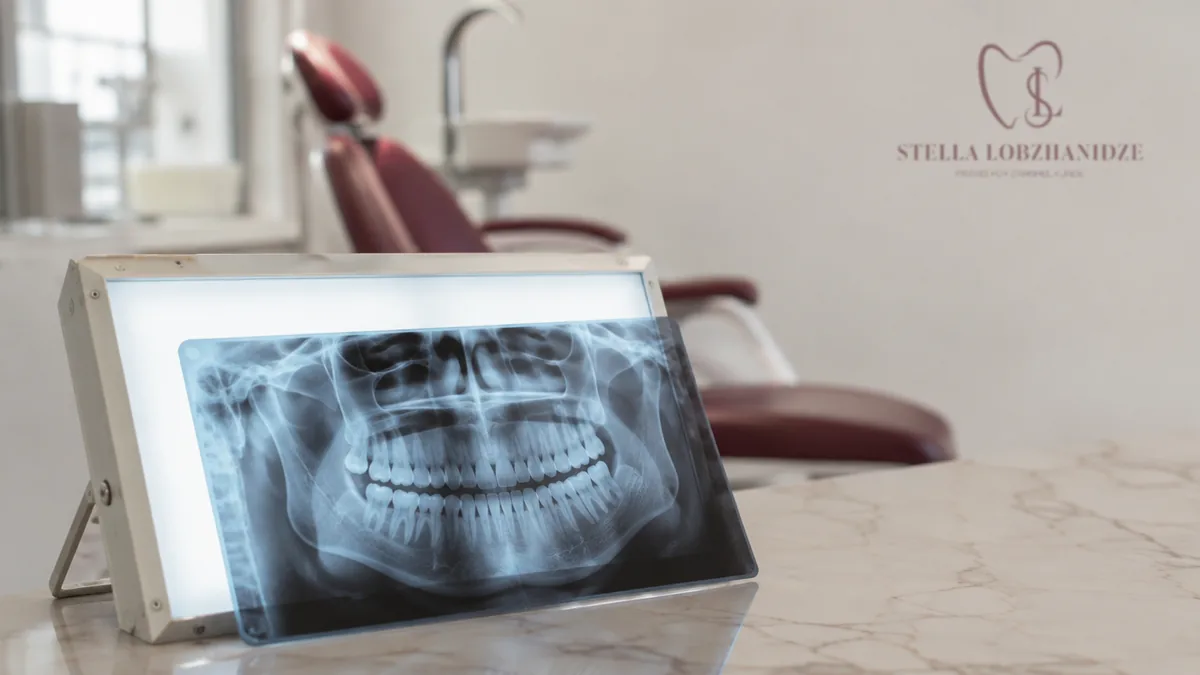
- panoramic X-ray: shows all teeth and both jaws in one image
- CBCT (3D X-ray): shows teeth, jaw and bone in three dimensions, for example to plan implants
How much radiation does a dental X-ray involve?
We are all constantly exposed to natural radiation from the environment. This makes the dose easy to compare. According to RadiologyInfo, a service of US radiology societies,
- a dental image equals about one day of natural radiation,
- a panoramic X-ray about three days,
- a CBCT scan about three weeks.
The German Federal Office for Radiation Protection gives 0.01 millisieverts for a dental image. The exact dose depends on the device and the type of image. A CBCT involves much less radiation than a CT scan.
How often can you have dental X-rays?
How often an X-ray makes sense depends on your situation. Your dentist decides each time whether an image is needed.
X-rays are usually harmless. However, many images over the years carry a very small additional risk. That is why X-rays are taken for a specific reason, not as a routine.
Why does your dentist ask about earlier X-rays?
Existing images can sometimes make a new one unnecessary. They also make it easier to spot changes over time.
If you change practice, bring any X-rays or reports you have. If you have an X-ray record card, show it and have new images entered.
How are you and your child protected during X-rays?
The Lower Austrian Dental Chamber lists several protective measures: X-rays are taken in dedicated rooms, and only a very small area is exposed. Modern devices emit very little radiation. In line with international developments, the Austrian health portal no longer recommends lead aprons for patients.
Children are more sensitive because they are still developing. They are therefore only X-rayed when symptoms make it necessary. According to the Dental Chamber, this should usually not happen before primary school age.
Can you have an X-ray during pregnancy?
Before any X-ray, say if you are pregnant or might be. Your dentist will then weigh the benefit and risk especially carefully.
Often an X-ray can be postponed or replaced by a method without radiation. According to the German Federal Office for Radiation Protection, the dose to the unborn child from a single standard examination is well below the threshold at which malformations can occur.
What imaging is available at Stella Dent?
Our practice in 1120 Vienna-Meidling has a CBCT device for three-dimensional images. It is especially helpful for planning implants and surgical procedures.
To look for tooth decay, especially between the teeth, we also use the DIAGNOcam. It shines light through the tooth instead of using X-rays, so it is well suited to children, pregnant women and anyone who wants to avoid radiation.
If you have questions about a planned X-ray, just ask us. You can book online or by phone on +43 1 813 31 23.
Book an appointment
Book online or give us a call.
Sources
- Zahnärztekammer Niederösterreich – PatientInnen-Information Zahnröntgen
- Bundesamt für Strahlenschutz – Röntgen: Dosiswerte und Röntgenpass
- Bundesamt für Strahlenschutz – Strahlenanwendungen und Schwangerschaft
- RadiologyInfo.org (ACR/RSNA) – Radiation Dose
- NHS – X-ray
- gesundheit.gv.at – Strahlenanwendung in der Medizin
- gesundheit.gv.at – Röntgenuntersuchung
This article is for general information only and does not replace a dental examination or advice.