Dental erosion: how acid attacks tooth enamel
Dental erosion is the loss of tooth enamel caused by acid, without bacteria being involved. The acid usually comes from drinks and food, sometimes from the stomach. Lost enamel does not grow back, but further damage can be slowed down.
By Stela Lobzhanidze, dentist in Vienna-Meidling
Published
Key points
- In erosion, acid dissolves the enamel directly, while in tooth decay bacteria produce the acid.
- Fruit juices, soft drinks, citrus fruit and vinegar are among the most common sources of acid.
- How often and how long acid acts on the teeth matters at least as much as the acid itself.
- Heartburn and frequent vomiting can also damage the teeth.
- Fluoride toothpaste, especially with stannous fluoride, helps to slow down further damage.
What is dental erosion and how is it different from tooth decay?
In dental erosion, hard tooth tissue is dissolved by acid. Bacteria play no part in this. Tooth decay is different: there, bacteria in dental plaque make acid from sugar.
How much damage occurs depends on several things. These include how strong the acid is, how long it acts, the mineral content of the food or drink and how much saliva you produce. Once enamel is lost, it cannot be restored.
Which drinks and foods attack tooth enamel?
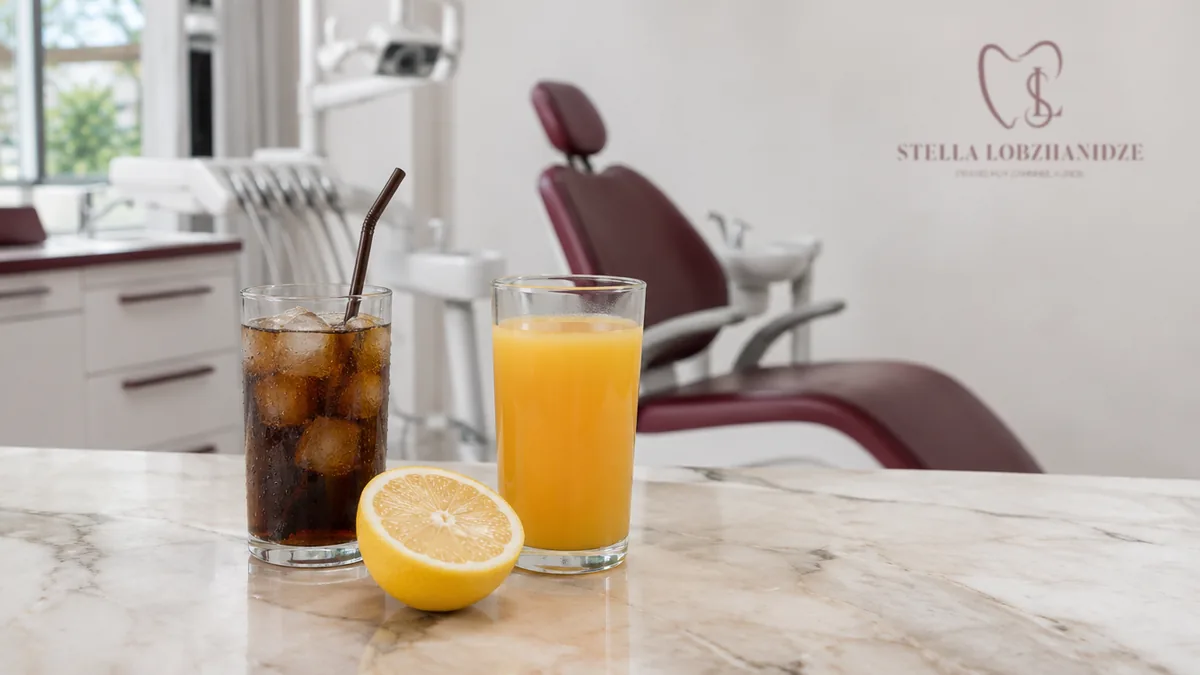
Acid is found in fruit juices such as apple and orange juice, in cola and lemonade, in citrus fruit, pineapple, passion fruit and apples, and in lemon juice and vinegar. Fruit juices can even harm the teeth more than soft drinks. Acidic effervescent tablets and vitamin lozenges can also contribute.
How you drink matters too. Sipping over a long time or swishing drinks around your mouth encourages erosion. This also applies to lemon water sipped throughout the day. Here is how to protect your teeth:
- Have juices and soft drinks with meals rather than in between.
- Dilute juices with water.
- Leave a break of several hours between acidic foods and drinks.
- Rinse briefly with water after something acidic.
- Chew sugar-free gum, as it stimulates saliva flow.
- Combine acidic foods with milk or yoghurt. Both contain a lot of calcium and phosphate.
On ingredient lists you can recognise acids by names such as citric acid, phosphoric acid, malic acid or tartaric acid.
Can heartburn damage your teeth?
Yes. With heartburn and reflux, stomach acid reaches the mouth. The same happens with frequent vomiting, for example during pregnancy or with an eating disorder such as bulimia.
Medicines that reduce saliva flow also increase the risk. Saliva dilutes acids and so protects the teeth.
If you often have heartburn, have the cause checked by a doctor. Your dentist can also take steps to protect your teeth.
Should I brush my teeth straight after acidic food?
For a long time the rule was to wait half an hour after acidic food before brushing. Experts at the University of Bern no longer see a benefit in this. Enamel needs days to months to take up minerals again, so half an hour makes little difference. The German dental chambers also see no problem in brushing straight after acidic food.
Brush gently and without pressing hard. Brushing too long and too hard is bad for the enamel.
After vomiting, the enamel is softened. Rinse your mouth with water straight away, but do not brush immediately.
How can you tell that your enamel is wearing away?
Erosion develops slowly and does not hurt at first. An early sign is that the teeth lose their natural shine.
As erosion progresses, the yellowish dentin shows through the enamel. When the damage goes deeper, teeth often become sensitive, for example to hot or cold drinks or when brushing.
Does toothpaste for sensitive teeth help against dental erosion?
Brush twice a day with fluoride toothpaste. According to the dental chambers, toothpastes and mouthwashes with stannous fluoride are currently the most effective way to slow down erosion.
Toothpastes for sensitive teeth often contain tin compounds or other ingredients that seal open tubules in the dentin. This can ease sensitivity. If your teeth are sensitive, choose a low-abrasion toothpaste.
At the practice, your dentist can protect your teeth with fluoride varnish. For more severe damage, a sealant, fillings or crowns may be options. Erosion cannot be reversed, but it can be slowed down and at best stopped.
How can Stella Dent in Vienna help?
At a check-up, your dentist can spot early signs of erosion and talk with you about possible causes. At our practice in 1120 Vienna-Meidling, we usually recommend a check-up and professional teeth cleaning twice a year.
We can also apply fluoride at these visits, either as gel in a soft tray or as varnish. You can book an appointment online at stelladent.termin365.at or by phone on +43 1 813 31 23.
Come to the practice if:
- your teeth look dull or lose their shine
- your teeth look more yellow than before
- your teeth are sensitive to cold, heat or brushing
- you often have heartburn or vomit frequently
Book an appointment
Book online or give us a call.
Sources
- Landeszahnärztekammer Thüringen u. a. – ZahnRat 89: Zahnerosion
- Zahnärztliche Mitteilungen (Universität Bern) – Erosives Potenzial von Getränken, Speisen und Medikamenten
- gesundheit.gv.at – Zahnpflege: So putzen Sie richtig
- Apotheken Umschau – Zahnpasta: Welche ist die richtige für mich?
- GOV.UK – Delivering better oral health: chapter 7, tooth wear
- Bundesamt für Lebensmittelsicherheit und Veterinärwesen (BLV) – Gesüsste und säurehaltige Getränke: Risiko von Zahnerosion
This article is for general information only and does not replace a dental examination or advice.